

When I first picked up needlepoint, I genuinely believed there was one stitch — the small diagonal one shown in every beginner video — and that everything else was decorative extra credit for advanced stitchers. It took a lumpy, uneven canvas corner, ruined by inconsistent tension, before I understood that different stitches solve different practical problems. They’re not just there to look impressive.
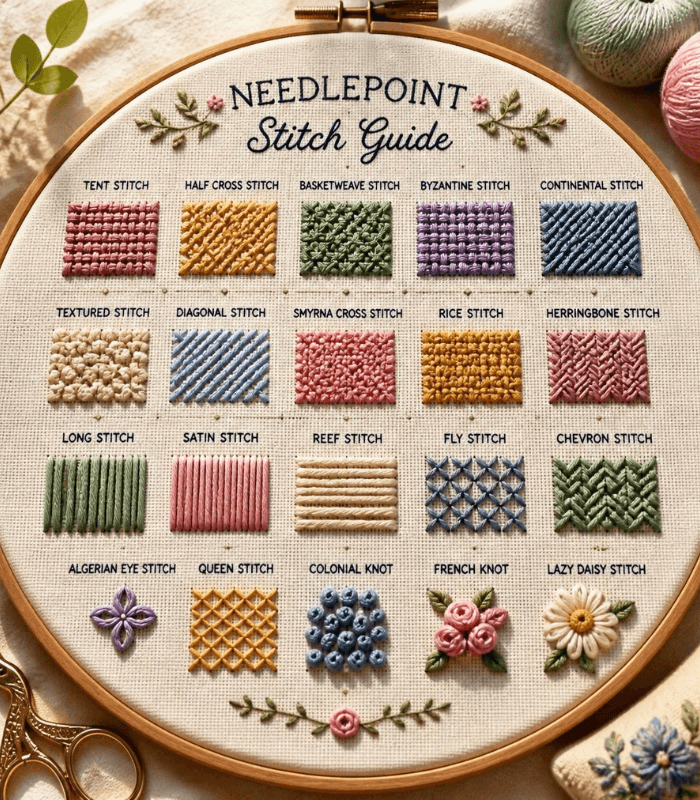
Tent stitch is the true foundation of needlepoint, a small diagonal stitch covering a single mesh intersection. What surprised me is that tent stitch actually splits into three distinct techniques, and beginners rarely get told this clearly upfront.
Continental stitch works in straight rows and is quick, making it useful for outlines or small color blocks. Its downside is that it distorts the canvas more noticeably, pulling it out of square as you go. Basketweave stitch, by contrast, moves diagonally instead of row by row, and it’s what I reach for on any large background area, since it barely warps the canvas and leaves a much neater, more even back — which matters if the finished piece will ever be seen from behind, like a book cover or a bag. Half-cross stitch looks identical to tent stitch from the front but uses noticeably less thread and offers far less durability, since it doesn’t fully anchor on the reverse side. I gave up on it entirely after a coaster I’d made wore thin within a single year of light use.
Beyond that foundational trio, needlepoint opens into genuinely decorative territory. Scotch stitch builds small textured squares from layered diagonal stitches, which I like for borders and frames. Byzantine stitch creates a zigzagging pattern that reads almost like a woven textile rather than embroidery. Mosaic stitch produces a compact block pattern that’s great for filling small geometric shapes cleanly. Cashmere and Milanese stitches both add subtle dimensional texture that photographs beautifully, though both take real practice to keep visually consistent across a large area.
The lesson that took me longer than it should have: match the stitch to the job, not to what looks trendy in a pattern book. Backgrounds want stability and even coverage, which is exactly what basketweave provides. Small detailed areas benefit from tent or continental stitch’s precision. Borders and accent areas are where the decorative stitches genuinely earn their place in a design. Once I started thinking about stitch choice functionally — what does this specific area of the canvas actually need — my finished pieces looked dramatically more polished, and it had nothing to do with buying better thread or more expensive canvas. It was entirely about matching technique to purpose.