

Fabric count confused me for far longer than I want to admit. I’d see “14-count” or “18-count” printed on a pattern and mentally file it away as some kind of difficulty rating, when really it’s just a measurement — and understanding exactly what it measures changes how you plan every single project from that point forward.
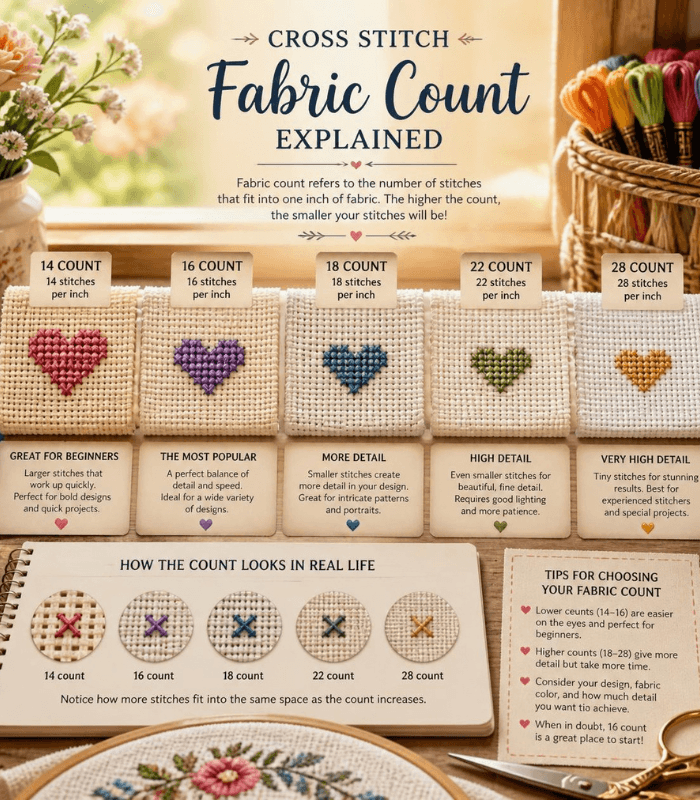
Fabric count is simply the number of stitchable squares packed into one inch of fabric. A 14-count Aida has 14 little squares across each inch, both horizontally and vertically. That’s the entire concept — no hidden complexity underneath it. But that one number quietly controls three separate things at once: the finished physical size of your piece, how much fine detail is even possible, and how comfortable the stitching feels on your eyes and hands over a long session.
Lower counts, roughly 11 to 14, have larger, more visible squares. They’re easier on tired eyes, faster to work through, and more forgiving if your tension isn’t perfectly consistent yet, which is exactly why most beginner-oriented patterns default to 14-count. I started there myself, and I still point new stitchers toward it before anything finer.
Higher counts — 18, 22, 28, and beyond — pack more squares into that same single inch, which allows for finer detail and richer shading, but also produces noticeably smaller, harder-to-see stitches. I moved up to 18-count for a portrait piece once I wanted more realistic shading around a face, and the added detail was worth it, though it was a genuinely slower and more demanding stitch than anything I’d done before.
Here’s the part that trips up almost everyone at some point: the exact same pattern produces a different finished size depending on the fabric count you choose to stitch it on. A design measuring 140 stitches across comes out to roughly 10 inches wide on 14-count fabric, closer to 7.8 inches on 18-count, and stretches to nearly 12.7 inches on 11-count. I learned this the expensive way, ordering a frame sized for a pattern’s default dimensions without checking which count I was actually using, and ending up with a finished piece that simply didn’t fit inside it.
There’s also linen and evenweave fabric to factor in, which is typically stitched “over two threads” rather than over a single printed Aida block. A 28-count linen worked over two threads behaves, in practice, almost identically to 14-count Aida — a detail that saves a lot of confusion once you know it, since the raw numbers on linen otherwise look deceptively fine.
My honest advice to anyone starting a new project now: calculate your finished size on your specific fabric count before you buy a single skein of thread. It takes about thirty seconds of simple division, and it will save you from the exact framing disaster I had to learn about the hard way.