
I once tried to finish a needlepoint canvas using embroidery floss because it happened to be sitting in my sewing box and I didn’t feel like making a trip to the craft store. Within the hour, the floss had thinned out, gone fuzzy, and left visible gaps of canvas showing through where the thread should have fully covered it. I ended up unpicking the entire section and starting over with proper wool. That one wasted evening taught me the difference between these two threads far better than any comparison chart could have.
The core issue is that embroidery floss and needlepoint thread are engineered for two different kinds of fabric, even though they’re often shelved next to each other in stores.
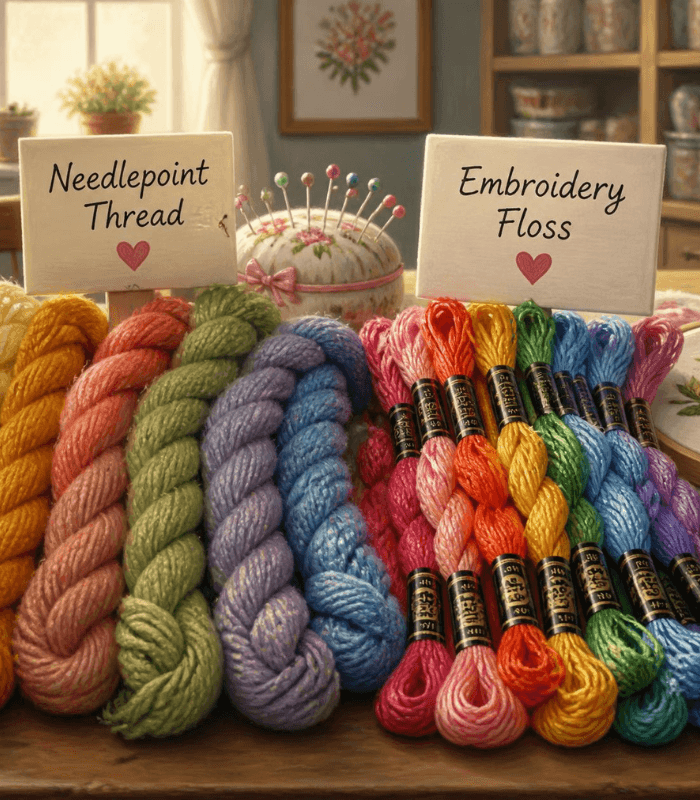
Embroidery floss — the familiar six-strand cotton skeins used in cross stitch — is built to glide repeatedly through tightly woven fabric like Aida or linen. It’s soft, splits easily into fewer strands for fine detail, and holds up beautifully to the small, repetitive in-and-out motion cross stitch demands.
Needlepoint thread has a tougher job. It has to survive being pulled through stiff, open canvas holes under real tension, and it has to fully cover the mesh so none of the underlying grid peeks through. That’s why needlepoint typically relies on wool or wool blends: Persian wool, which comes in three separable plies you can adjust for thickness, tapestry wool, a thicker single strand that isn’t meant to be split, and pearl cotton, which has a twisted, slightly glossy finish that behaves nothing like soft floss.
I’ve made the floss-on-canvas mistake more than once out of pure laziness, and the result is always the same — thin, patchy coverage, because floss simply wasn’t designed to fill open mesh the way wool is. The reverse mistake, wool on Aida, causes its own problem: the fabric’s tight weave gets stretched and distorted by yarn that’s simply too thick for it.
Strand count matters just as much as fiber choice. Floss comes as six loosely twisted strands, and you separate however many you need based on fabric count — two strands is a common starting point on 14-count Aida. Persian wool works in a similar but reversed way: you separate its three plies and recombine them depending on your canvas’s mesh size, using more plies to cover larger mesh and fewer for finer work.
If I’m honest, the real skill here was never memorizing which thread pairs with which fabric. It was learning to test a small corner before committing to an entire project. I do this now with every new material combination, even ones I think I already understand, because a five-minute test stitch has saved me from redoing hours of work more times than I can count. Whatever you’re working on, letting the fabric tell you what thread it needs — rather than grabbing whatever’s closest — is the habit that actually prevents wasted evenings.