
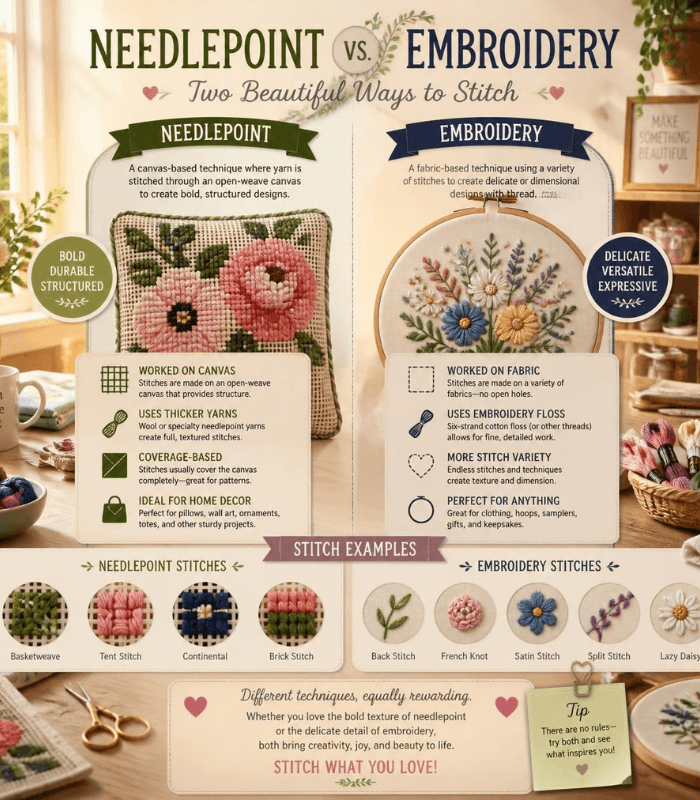
Needlepoint is counted grid work on rigid canvas with thick yarn. You cover every square methodically. Embroidery is freehand stitching on soft fabric with thin thread—no grid, total creative freedom. Completely different crafts. Completely different feels.
Table of Contents
Canvas vs Fabric: The One Thing That Changes Everything
Here’s where I’ll be honest with you: I made every beginner mistake possible when I started. But the biggest one? I thought needlepoint and embroidery were interchangeable.
Needlepoint happens on rigid mesh—mono canvas, penelope canvas, or interlock. It’s a pre-punched grid. Literally every hole is numbered and mapped. You’re painting with yarn following a roadmap. It feels structured, predictable, meditative.
Embroidery happens on regular soft fabric—linen, cotton, silk, whatever. No grid. No map. You’re either stitching freehand or following a drawn-on pattern. It feels loose, creative, free.
Can’t swap these. Trust me, I’ve seen people try.
The Stitches Are Completely Different (Here’s Why)
Needlepoint lives on tent stitch, cross stitch, Parisian stitch, Milanese stitch, Byzantine stitch, rice stitch, and variations. Every stitch covers one predetermined square. Every stitch is counted. I use basketweave tent stitch for almost everything because it’s durable and sits perfect.
The thing about needlepoint? You’re filling squares. Paint-by-numbers with a needle. Meditative. Rhythmic. Honestly, it’s why people love it.
Embroidery is wild. Backstitch, satin stitch, French knots, split stitch, long and short stitch, shadow embroidery, drawn thread embroidery. You can place stitches literally anywhere. Mix techniques in one project. Sketch with your needle. It’s creative chaos in the best way.
This happened to me: I’d worked needlepoint for five years before trying embroidery. The first project without a grid? Absolute panic. No roadmap. But then something clicked. That freedom to experiment, to adjust, to create without following rules—that became my favorite part. Now I can’t imagine doing just one.
The Tools Situation: Can’t Wing It
Want to know the most frustrating thing? Using wrong tools. I’ve watched beginners struggle for hours because they grabbed the wrong needle or thread.
Needlepoint needs: Tapestry needles (blunt—they slide through canvas), thick yarn (3-4 ply usually), counted canvas (14-18 count is standard), and a frame or stretcher bar for tension.
Embroidery needs: Embroidery needles (sharp point—they pierce fabric), thin embroidery floss (separates into 6 strands), soft fabric, and an embroidery hoop.
Can you use embroidery floss for needlepoint? Technically yes. But it’ll look thin and sad. Try needlepoint yarn on embroidery fabric? The thick yarn tears delicate linen. Just don’t.
Needlepoint vs Cross Stitch (Clear This Up Now)
People always ask me: “Isn’t cross stitch just needlepoint?” Honestly? Kind of. Cross stitch is technically a needlepoint stitch—one X per counted square. But it became its own thing because it’s simpler. One stitch type. Clear pattern. Very beginner-friendly.
Needlepoint uses multiple stitch types creating textured, complex designs. Cross stitch is the entry point. Needlepoint is the advanced path. Different categories now, but related.
Which One Should You Actually Start With?
Pick needlepoint if: You like structure and clear instructions. You want something durable for pillows or stockings. You love meditative repetition. You want richly textured finished pieces. You’re good with following a pattern exactly.
Pick embroidery if: You want creative freedom. You like mixed techniques. You’re adding designs to clothing or bags. You want finer detail. You like working quickly. You want to skip the technical finishing process.
Honestly? Start whichever excites you more. Both have learning curves. Both are rewarding as hell.
Real Talk on Finishing
Nobody talks about this: finishing costs money. Needlepoint finishing (blocking, making into pillows, professional assembly) can cost 1.5-3x the stitching cost. Embroidery finishing? You usually do it yourself.
Budget accordingly if needlepoint is calling you.
FAQ: The Questions I Get Asked Every Time
Can I use needlepoint patterns for embroidery?
Yes, but you’re translating, not copying. Needlepoint patterns are gridded. Transfer that to embroidery by outlines and fills. It works beautifully but requires adapting.
What’s harder—needlepoint or embroidery?
Needlepoint is more structured (easier roadmap), embroidery is more forgiving (you can fix mistakes). They’re equally challenging but differently. Needlepoint: gentler learning curve. Embroidery: more creative potential.
Do embroidery needles differ from sewing needles?
Yes. Embroidery needles are sharp and designed for piercing fabric precisely. Sewing needles are different. Use the right tool—your hands will thank you.
What about petit point?
Petit point is just needlepoint on very fine canvas (18+ count). Same technique, more intricate. Embroidery petit point is different—fine embroidery on delicate fabric.
The Honest Ending
Here’s what I tell beginners: get a decent needlepoint starter kit or embroidery DIY art kit, start small, and commit to learning it properly. The needlework community is generous. Join local groups. Find online embroidery and needlepoint communities. Ask questions.
By Sara McLean