

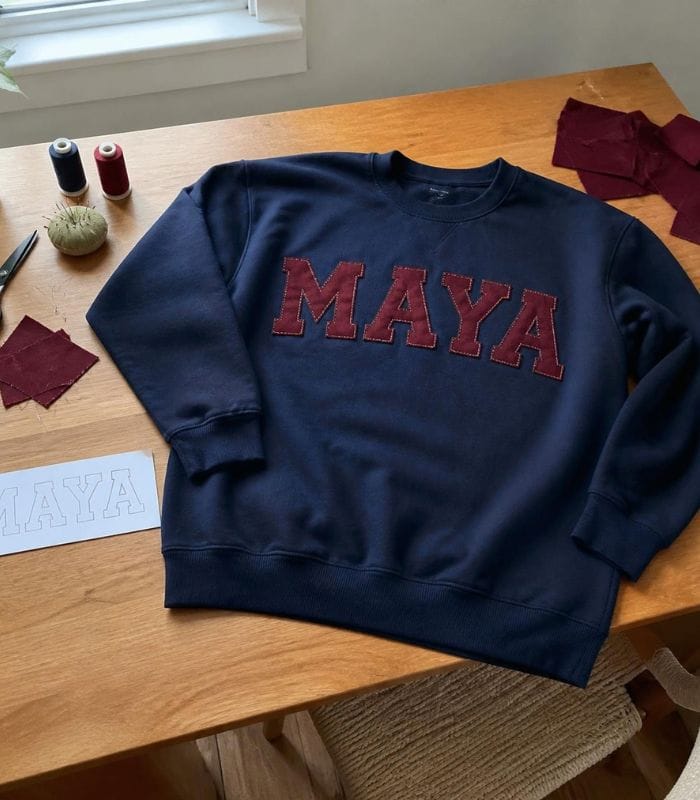
I was terrified of ruining it. That’s the honest truth nobody tells you when you’re learning reverse appliqué for the first time.
Three years ago, I bought this oversized navy sweatshirt from a thrift store—the kind with perfect weight that makes you never want to take it off. My roommate Maya’s birthday was coming, and I got this crazy idea: I’d personalize it with her name using some technique I barely understood. I’d watched a fifteen-minute YouTube video. That was my entire qualification.
I had no sewing machine. No experience. Just dull kitchen scissors, fabric paint that didn’t work, and desperation to make something meaningful.
The Moment Everything Changed
That’s when I discovered reverse appliqué. Not as a vague concept, but as an actual solution to my disaster. I found this video of a woman with paint-stained hands showing how you layer fabrics, carefully cut away the top layer, and stitch around the edges. Your custom text appears like magic—dimensional, intentional, real.
I drove to the fabric store with $8 and grabbed cream-colored cotton to cover my mistakes and burgundy fabric for what would show through as letters. I had no plan. Just hope.
At my kitchen table, I marked out M-A-Y-A with a shaky hand. Then I started cutting. Very slowly. Each snip felt monumental because I couldn’t undo it. My heart was literally racing over fabric scraps—which seems ridiculous until you’re actually doing it.
The cutting took maybe twenty minutes. My neck was tense. My brain kept screaming “what if this looks terrible?” But then I threaded a needle and started stitching around the first letter. That’s when something shifted. As I stitched, the burgundy actually appeared underneath. Like I was revealing something that was always meant to be there.
Why This Matters More Than You Think
I stitched for three hours straight that first night. My fingers hurt. The thread tangled every five minutes. My stitches were uneven and honestly kind of sloppy. But something inside me felt alive in a way I hadn’t expected.
The technique itself is straightforward: layer your fabrics, mark your custom text clearly, cut carefully around the letters leaving about a quarter-inch seam allowance, then hand stitch around each edge. Use thread that matches your contrasting fabric. Keep your stitches small and even—about an eighth of an inch. That’s literally it.
But here’s what nobody mentions: the real work is the stitching. That’s where reverse appliqué becomes meditative. It’s not fast. It’s not easy. But it’s exactly the kind of slow, intentional work our brains desperately need.
When I gave Maya that sweatshirt, she cried. Not because it was perfect—my letters were slightly uneven and my stitching looked like a beginner made it—but because I’d done it by hand. She wore that sweatshirt constantly for two years. The seams held through dozens of washes.
The Process: How I Actually Do It
Step 1: Choose and Prepare the Fabrics — Pick substantial base fabric like a sweatshirt and contrasting fabric that pops, then press everything flat because wrinkles will drive you crazy.
Step 2: Create Your Custom Text — Write or print your design on paper first to see if it actually looks good before you commit to cutting fabric.
Step 3: Layer the Fabrics — Place contrasting fabric on top of your base and secure with temporary fabric adhesive (pins slide around and ruin everything).
Step 4: Mark the Letters — Carefully trace your custom text onto the top layer with fabric pen, double-check everything, because once you start cutting, there’s no going back.
Step 5: Cut the Top Layer — Cut carefully around each letter with sharp scissors, leaving about a quarter-inch seam allowance (dull scissors will destroy you—trust me).
Step 6: Hand Stitch Around the Letters — Thread your needle with matching thread and stitch small, even stitches (about an eighth of an inch) around each letter until the magic happens.
Step 7: Finish and Secure the Appliqué — Press gently with cool iron, trim loose threads, and add a second stitch pass if this will be worn constantly.
What I’ve Learned Since Then
I’ve made seven more reverse appliqué sweatshirts since Maya’s. I’ve attempted how to reverse appliqué custom text on t-shirts (harder than you’d think—thin fabric moves around). I’ve tried incorporating embroidery details, tested raw edge versus finished edges, and made one ambitious reverse appliqué flower design I still don’t talk about.
Every single piece has imperfections. My stitches still aren’t perfectly even. Letters still tilt slightly. Some threads came loose. And honestly? I love every single flaw. Those imperfections prove a real human made this with their hands and patience and willingness to risk failure.
That’s the real lesson in how to add custom text with reverse appliqué. It’s not about achieving perfection. It’s about creating something that matters because you made it. About sitting down for three hours and stitching someone’s name into fabric with intention.
If you’re thinking about trying this—start small. A monogram. Someone’s nickname. A reverse appliqué sweatshirt with meaningful words. Don’t overthink it. Use sharp scissors (throw away dull ones). Layer your fabrics properly. Stitch slowly and deliberately.
Your first piece won’t be perfect. Mine wasn’t. But it will be yours, and that’s worth infinitely more.
Why Knits Beat Wovens
Here’s the secret nobody tells you: choose knit fabrics like sweatshirt fleece or jersey for your base, not woven cotton. I learned this the hard way when my first woven fabric piece started fraying everywhere within weeks. Knits are forgiving—their raw edges don’t unravel like wovens do, which means your finished piece stays perfect through dozens of washes without you having to finish every single edge. That’s why sweatshirts are so beginner-friendly. Pick knits, and your reverse appliqué will actually last.
FAQ
How do I reverse appliqué custom text?
Layer contrasting fabrics, mark the letters, cut the top layer, and hand-stitch around the edges.
Can I reverse appliqué letters by hand?
Yes. Hand stitching gives you better control, especially around small letters and curves.
Can I reverse appliqué a sweatshirt?
Yes. Sweatshirts work well, but secure the layers so the fabric doesn’t shift while cutting.
Can I reverse appliqué a T-shirt?
Yes, but thin knit fabric can stretch, so stabilize it before cutting and stitching.
How do I prevent reverse appliqué edges from fraying?
Use close, even stitches around the cut edges and secure the stitching well.
How do I keep reverse appliqué letters even?
Use a printed template to plan the size, spacing, and placement before cutting.
Written and tested by the AppliquéFits team and Sarah McLean