
The first canvas I ever bought was chosen entirely because I liked the picture printed on it. I had no idea what “mesh count” meant, and I paid for that ignorance with a needle I bent trying to force through holes that were far too small for the yarn I’d brought. That single frustrating evening taught me more about canvas than any beginner guide ever did, mostly because I had to slow down and actually understand what I was working with.
Needlepoint canvas isn’t a single material — it’s a small family of woven grids, each built for a slightly different purpose, and the differences matter more than they look like they should.
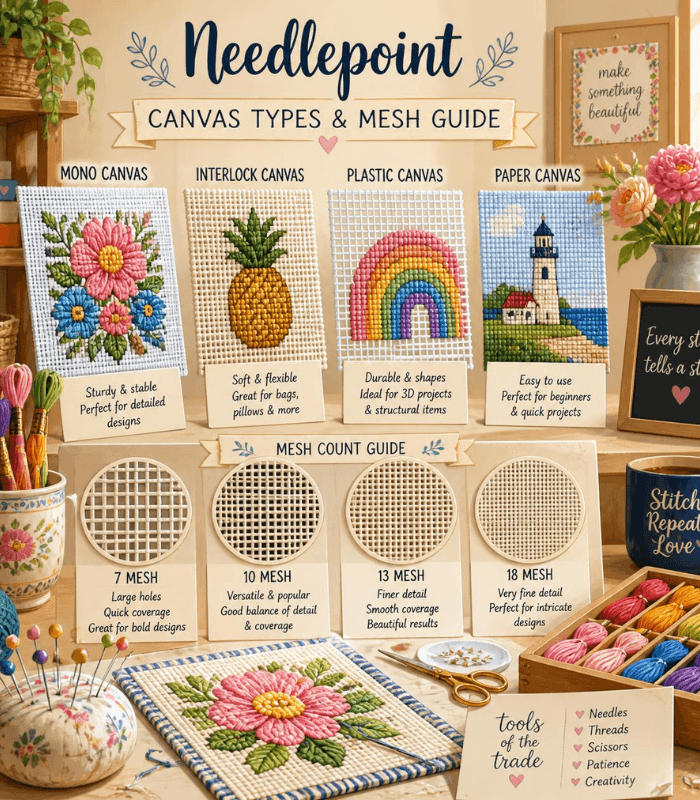
Mono canvas is the plain, single-thread grid most beginners eventually land on. It’s easy to stitch on and forgiving when you need to rip out a mistake, which happens more than any of us like to admit. Its one downside is that the threads can shift slightly where they cross, so your tension has to do a bit more work to keep things looking even.
Interlock canvas fixes that shifting problem by twisting the vertical threads around the horizontal ones, locking the grid in place. I switch to interlock whenever I’m doing large stretches of basketweave stitch, because the added stability shows up in the smoothness of the finished surface.
Penelope canvas looks like a doubled version of mono canvas, and functionally, it kind of is. Those paired threads can be separated to stitch fine detail — faces, lettering, small motifs — at double the usual density, then brought back together for the surrounding background. It’s a genuinely clever piece of textile engineering, though I wouldn’t hand it to someone stitching their first piece.
Then there’s plastic canvas, which barely resembles the others. It’s rigid, doesn’t fray at the edges, and needs no frame or stretcher bars, which is exactly why it turns up in ornaments, coasters, and tissue box covers rather than framed wall art.
Mesh count is the number that quietly runs the whole show
It tells you how many holes exist per inch, and that single figure determines your needle size, your thread weight, and realistically how much detail you can pack into a design. A 10-mesh canvas is bold and quick to work — good for rugs or oversized pillows meant to be seen from across a room. An 18-mesh canvas is where a lot of traditional needlepoint lives, fine enough for genuine shading and gradient work. Push past 24 mesh into petit point, and a single square inch can eat up an entire afternoon.
The mistake I made, and one I still see constantly in stitching communities, is judging a canvas by its printed artwork instead of its mesh number. A richly detailed design on 18 mesh is a completely different undertaking than the same image printed on 13 mesh, even though the picture looks identical on the packaging. Before buying, skip past the pretty preview and find the actual mesh count, usually printed along the canvas edge or listed in the product details.
Understanding mesh isn’t really about memorizing numbers — it’s about matching your material to your patience level and your eyesight on a given day. Some evenings call for a chunky 10-mesh project I can stitch while half-watching television. Other times I want the meditative slowness of 18-mesh work. Knowing the difference between mono, interlock, Penelope, and plastic canvas, and reading mesh count before you buy, is what turns needlepoint from a guessing game into a craft you can actually plan around.