
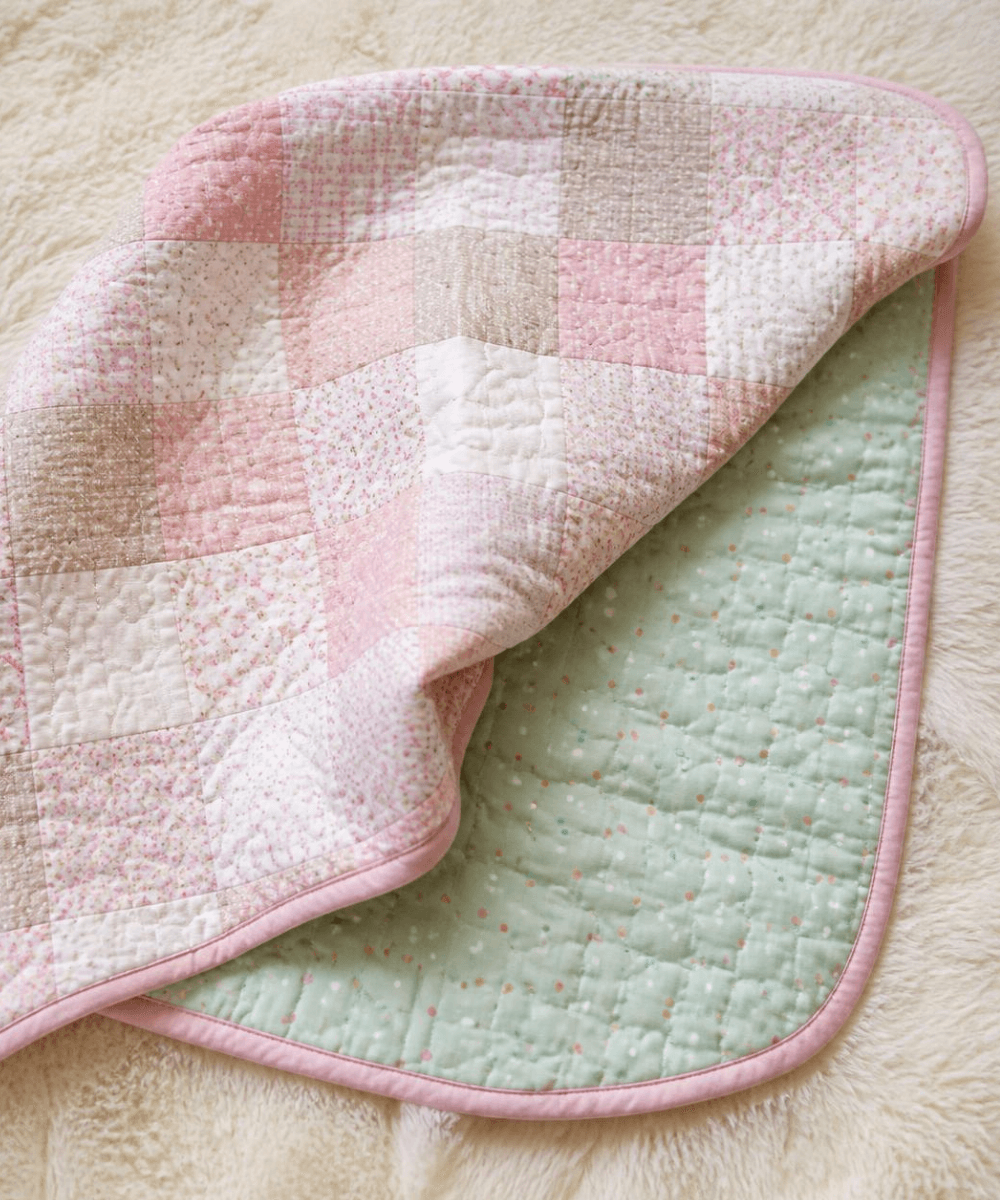
A baby quilt is built the same way as any standard quilt — top, batting, backing, quilted, bound — but with three real constraints a full-size quilt doesn’t have: it needs to be washed frequently and aggressively, it needs to stay lightweight enough not to overheat a baby, and every material in it needs to pass basic safety scrutiny for something an infant will be in direct, prolonged contact with. Those constraints, more than size, are what should drive the batting choice.
Table of Contents
Choosing Batting for a Baby Quilt
Low-loft cotton or a cotton-poly blend is the standard recommendation, for three concrete reasons:
- Cotton and cotton-blend battings are more breathable than pure polyester, reducing overheating risk.
- Low loft (under 1/4 inch) keeps the finished quilt light rather than heavy and puffy.
- Cotton battings are typically more machine-washable and shrink-tested for repeated laundering, which a baby quilt will need constantly.
Pure polyester batting is not unsafe, but it retains heat more than cotton and is less breathable — a real consideration for anything a baby sleeps under or near. Where polyester makes sense for a baby quilt is in a lightweight, low-loft, needle-punched form used specifically for durability through frequent washing, not for the loft or warmth polyester is chosen for in adult bedding.
How to Sew a Baby Quilt with Batting
- Cut and piece the top. Standard baby quilt sizes run 36×36 to 45×60 inches; a simple 6×6 grid of 6-inch squares (finished) makes a 36×36 quilt and is a reasonable first-project size.
- Cut batting and backing slightly larger than the pieced top — 2 to 4 inches oversized on each side — to allow for shifting during quilting.
- Layer the sandwich: backing right-side down, batting centered on top, quilt top right-side up, smoothed from the center out.
- Baste: pin every 3 to 4 inches, or use basting spray for a smoother machine-quilting surface. Basting spray is safe for baby quilts once fully cured (allow it to off-gas per the product’s instructions before continuing).
- Quilt: a simple grid or straight-line pattern is both easiest for a first project and holds up well to repeated washing, since dense straight lines distribute stress evenly.
- Bind: trim the excess batting and backing flush with the top, then apply binding — either standard folded-strip binding, or for a simpler finish, the pillowcase method (see below).
Sewing a Baby Quilt with Batting: The Pillowcase Method
The pillowcase method skips separate binding entirely. Backing and top are sewn right sides together with batting on the outside of the sandwich, leaving a gap; the whole thing is turned right-side out through the gap, the gap is hand- or machine-stitched closed, and the quilt is then quilted through all three layers. It produces a finished edge without bias binding, which is faster for a first baby quilt and gives a soft, rounded edge rather than a defined binding strip — a common preference for infant items.
Binding a Baby Quilt with No Extra Batting
Some baby quilt patterns — particularly minky-backed or flannel-backed designs — skip a separate batting layer entirely and rely on the loft of a plush backing fabric alone. In that case, binding still follows the same process (folded strip or pillowcase method), just applied to a two-layer rather than three-layer sandwich. This produces a flatter, lighter blanket that’s common for swaddle-weight baby quilts rather than a quilted bedding piece.
Baby Quilt of Cotton Squares with Flannel for Batting
Using flannel instead of true batting as the middle layer is a specific, common baby quilt technique: cotton squares pieced for the front, a single layer of flannel in place of batting, and a cotton or flannel backing. It produces a flatter, softer quilt than one made with true batting — closer to a heavy blanket than a puffy quilt — and it’s a favored construction for baby quilts specifically because flannel adds warmth without the loft or bulk of batting, and it launders easily without the risk of clumping that thin, low-quality batting can develop after repeated washing.
DIY and Easy Baby Quilt Approaches
For a genuinely easy first baby quilt: a single layer of flannel as the “batting,” a simple 2-fabric pieced top (or even just two coordinating pre-cut fabric panels), and the pillowcase binding method removes both the batting-loft decision and the binding step — the two parts of quilt construction most likely to slow down a first-time project. This isn’t a lesser version of a “real” baby quilt; it’s a standard, widely used construction method, just with fewer components.
FAQ
Does a baby quilt need to be quilted densely, or is minimal quilting safe?
Quilting distance should still respect the batting’s stated maximum (usually 8–10 inches for cotton or cotton-blend battings), the same rule that applies to any quilt. Minimal quilting is fine as long as it stays within that spacing — it doesn’t need to be dense, just even.
Is polyester batting safe for a baby quilt?
Yes, in terms of material safety — polyester batting used in baby products is manufactured to the same textile safety standards as other batting. The consideration is comfort and overheating risk, not safety, which is why cotton or cotton-blend is more commonly recommended over pure polyester for infant bedding specifically.
How much should I prewash before starting?
Prewash all fabrics, including flannel, before cutting — flannel in particular shrinks more than quilting cotton on its first wash, and skipping this step causes visible puckering at the seams after the finished quilt’s first laundering.
 Minty Mellon