

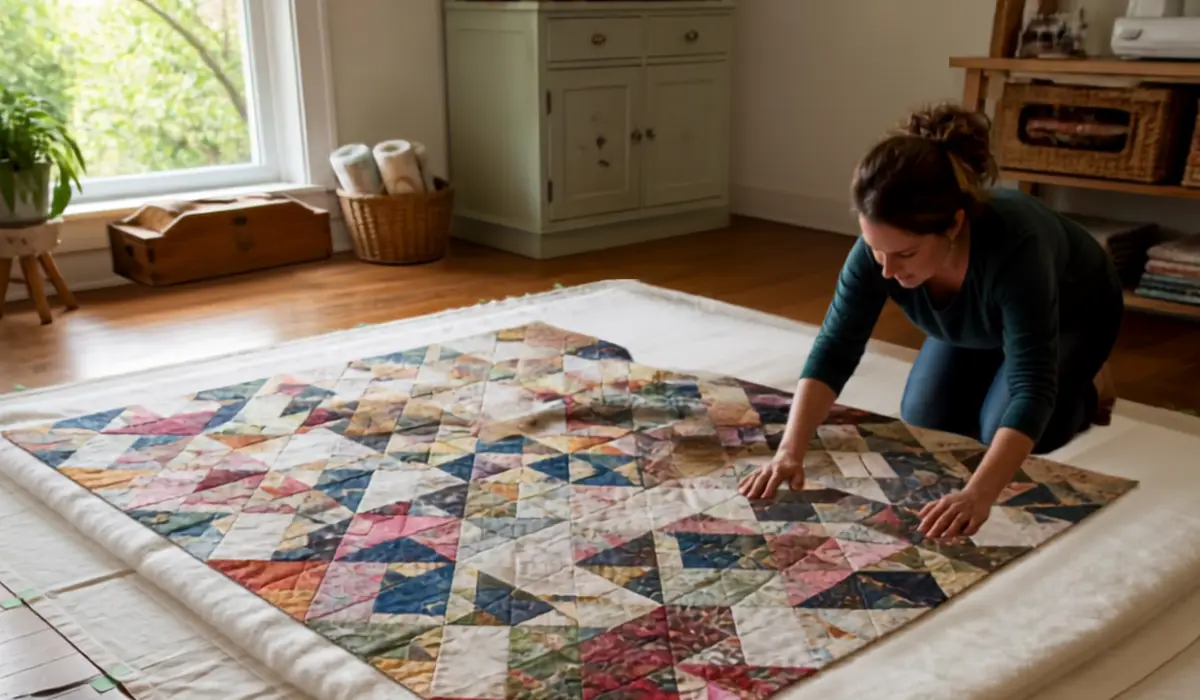
Putting a quilt together with batting means layering three separate pieces — your backing, your batting, and your finished quilt top — into one stable unit you can stitch through. Quilters call this the quilt sandwich, and once it’s built and secured, it’s ready for quilting and binding. The layering itself isn’t complicated, but there’s a right order to do things in, and a handful of small habits that separate a quilt that lies flat for years from one that puckers the first time it’s washed.
I still remember putting together my very first quilt sandwich on my kitchen floor, taping the backing to the linoleum with painter’s tape because I didn’t own a proper frame. It turned out fine, wrinkles and all — you really don’t need fancy equipment to get this right, just patience and a big enough flat surface.
Table of Contents
What You’ll Need Before You Start
- A finished, pressed quilt top
- Backing fabric, several inches larger than your top on every side
- Batting, cut to roughly match your backing size
- Pins (curved safety pins work best) or basting spray
- A large flat surface — a table, a clean floor, or a design wall
Pressing matters more here than people expect. Any wrinkle or unpressed seam in your quilt top gets locked into the finished piece permanently once quilting stitches lock everything together.
Layering the Sandwich
Start with the backing, right-side down. If you’re working on a hard floor or table, secure the edges with painter’s tape so the fabric stays flat and taut, but be careful not to stretch it — an overstretched backing will pucker once the tape comes off.
Add the batting next. Unroll it carefully over the backing and smooth out any folds. Batting wrinkles easily, especially if it’s been stored rolled up for a while, so give it a few minutes to relax flat before smoothing it into place.
Center your quilt top, right-side up, on top of the batting. You should see an even border of batting and backing peeking out around all four sides once it’s centered.
Smooth everything from the center out. Working outward from the middle pushes air pockets and slack fabric toward the edges instead of trapping them somewhere in the middle of your quilt.
Securing the Layers
Once your sandwich is built, it needs to be basted before you touch it with a needle. Skipping this step is the single most common reason quilts shift, bunch, or develop hidden folds during quilting.
- Pin basting works well for most home quilters — place curved safety pins every 4 to 5 inches across the whole surface.
- Spray basting uses a temporary fabric adhesive and is faster for larger quilts, though it needs a well-ventilated space.
- Hand basting with thread is slower, but some quilters still prefer it for the control it gives, especially on smaller or more delicate pieces.
Whatever method you pick, don’t rush it. A quilt that’s basted generously quilts up smoothly; one that’s basted sparsely tends to fight you the whole way through.
Quilting and Finishing
With everything pinned or sprayed in place, you’re ready to quilt through all three layers. A walking foot makes this easier on a home machine, since it helps feed the top and backing at the same rate instead of letting one layer shift ahead of the other. After quilting, trim the extra batting and backing flush with your quilt top, then finish the raw edges with binding.
Mistakes That Cause Problems Later
- Taping the backing down too tightly, which causes puckering once it’s released
- Leaving folds or wrinkles in the batting layer, assuming they’ll smooth out during quilting
- Basting too sparsely, especially on larger quilts where fabric has more room to shift
- Trimming the batting and backing before quilting is fully finished
A Few Habits Worth Building
- Work on a surface bigger than your quilt whenever possible, even if that means clearing the living room floor.
- Let rolled batting sit unrolled for a while before layering it, so it lies flatter from the start.
- Baste more generously than feels necessary; it’s much easier to remove extra pins than to fix a shifted layer mid-quilting.
FAQ
How much bigger should the backing and batting be than the top?
A few inches larger on all sides gives enough margin for shifting during quilting and makes trimming afterward much easier.
Can I put a quilt together without a frame?
Yes, a table or clean floor works fine for most home quilters. A frame just makes larger quilts more manageable.
What’s the fastest way to baste a large quilt?
Spray basting tends to be quickest for bigger projects, since it skips the time-consuming process of placing hundreds of pins.
Why does my quilt pucker after I’ve finished it?
Puckering is usually traced back to an overstretched backing, wrinkled batting, or basting that wasn’t thorough enough before quilting began.
Does the order of layering matter?
Yes. Backing goes down first, batting in the middle, and the quilt top last, right-side up, so the finished quilt has a right and wrong side.
Written By Sara McLean, Textile & Appliqué Specialist — 12+ years quilting experience
 Minty Mellon