

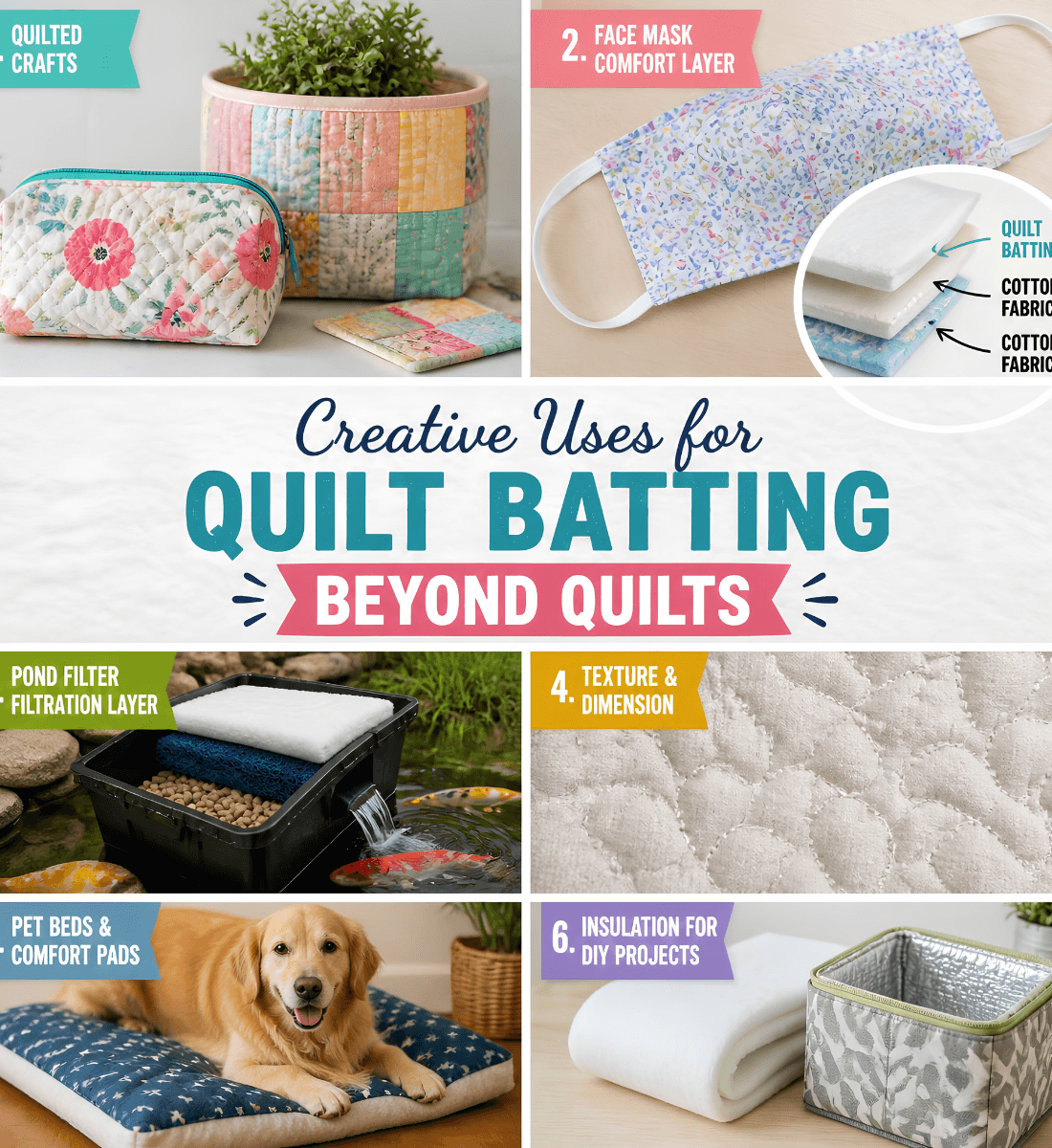
Quilt batting’s core properties — a fibrous, filterable, compressible layer — make it useful for a few projects that have nothing to do with quilts. These are legitimate, if niche, uses worth a separate note from standard quilting technique, since the sourcing and handling considerations are different.
Table of Contents
Face Masks with Quilt Batting
Quilt batting was widely repurposed as a filter-layer insert for cloth face masks, sandwiched between two layers of woven cotton fabric rather than used as the mask’s outer material.
How to make a face mask with quilting batting:
- Cut two layers of tightly woven cotton fabric (quilting cotton works) to the mask pattern.
- Cut a piece of thin, low-loft batting to the same shape, slightly smaller to avoid bulk at the seams.
- Sandwich the batting between the two cotton layers and construct the mask as the pattern directs, treating the three-layer piece as a single unit through the seams.
- Use a low-loft, needle-punched batting rather than high-loft polyester — bulk in a mask’s filter layer affects both fit and breathability.
Important caveat: cloth mask filtration effectiveness depends heavily on the specific fiber and weave, and quilt batting was never independently tested or certified to the standard that N95 or surgical-grade filtration material is. For any use case with real health stakes, follow current public health guidance on mask materials rather than relying on quilt batting as a substitute for tested filtration media.
DIY Pond Filter with Quilt Batting
Batting’s density and fiber structure let it function as a mechanical pre-filter in small DIY pond or aquarium filtration setups, trapping debris and particulate before water reaches a pump or biological filter stage.
How to make a pond filter with quilt batting:
- Use polyester batting specifically, not cotton — cotton batting breaks down and decomposes in prolonged water contact, while polyester is inert and holds up over time.
- Cut or layer the batting to fit inside a filter housing, bucket, or mesh bag positioned ahead of the pump intake.
- Rinse and replace the batting regularly, since it will clog with debris faster than a purpose-built filter pad.
This is a genuinely functional low-cost substitute for commercial filter media in small setups, but it’s a mechanical pre-filter only — it doesn’t replace biological filtration stages needed for a healthy pond ecosystem in anything beyond a very small, lightly stocked setup.
Getting a Quilted Look with Thin Batting
For projects where the goal is the visual texture of quilting — the raised, channeled look of stitched batting — without the weight or bulk of a full quilt, a thin, low-loft batting (often labeled “craft” or “high-loft-free” batting, under 1/8 inch) sandwiched and stitched between two fabric layers produces the effect at a fraction of standard quilt batting’s thickness.
Getting a Quilted Look with Thin Batting for Costumes
This technique shows up specifically in costume construction, where a quilted aesthetic (jacket linings, historical garment reproductions, structured bodice pieces) is wanted without the stiffness a full quilt sandwich would add to a wearable garment.
- Use the thinnest craft or garment-weight batting available — costume applications prioritize drape and movement over the loft that bedding-weight batting provides.
- Stitch in the pattern the costume calls for (channel quilting for structured pieces, decorative stitching for surface texture) using the same basting principles as standard quilting, scaled down.
- Fusible thin batting is common in costume work specifically because it avoids adding pin-basting bulk to a garment piece that will also go through fitting and alteration.
FAQ
Is quilt batting reusable in a pond filter, or does it need constant replacement?
Polyester batting can be rinsed and reused several times before it needs replacing, though it will eventually break down or become too clogged with fine debris to rinse clean — expect to replace it more frequently than a commercial filter pad designed for repeated use.
Can regular quilt batting be used in a mask without any special preparation?
No specific preparation is required beyond using clean, unused batting, but standard batting isn’t manufactured or tested as a filtration product — treat it as a comfort/structure layer in a cloth mask rather than a certified filtration material.
What loft of batting gives the most realistic quilted texture for costumes without adding bulk?
The thinnest available craft-weight battings, typically under 1/8 inch loft, give visible stitched texture without meaningfully changing how the fabric drapes or moves — standard quilt-weight batting is noticeably too thick for most garment applications.
 Minty Mellon