
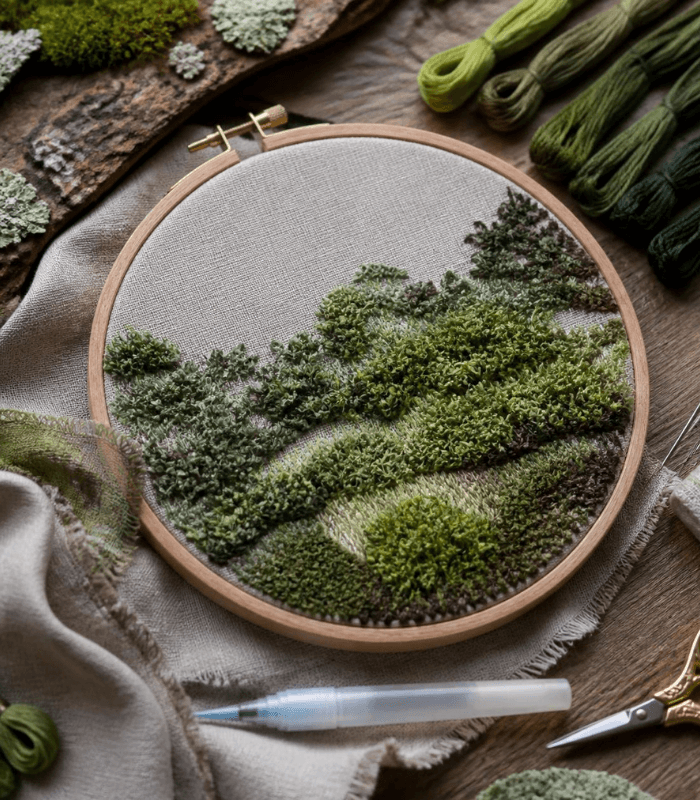
You want to know a secret? The moss stitch is literally my favorite thing to teach because it’s stupidly easy but looks absolutely gorgeous. I’m talking five years of embroidery work, and I still get excited about stitching moss effects. It’s just that satisfying.
Table of Contents
Here’s Exactly How to Do the Moss Stitch
Okay, so I’m gonna be honest—the moss stitch freaked me out when I first started. I thought it had to be some complicated technique. Nope. It’s literally just back stitches going in random directions. That’s it. You grab your moss thread, do 3-5 stitches going one way, then jump somewhere else and stitch in a totally different direction. Repeat until it looks like moss. Done.
The first time I tried embroidered moss, I was stressed about making it perfect and symmetrical. Real moss? It’s messy. It’s chaotic. That’s what makes it beautiful. My best embroidery moss comes from just letting go and stitching randomly—soft texture, overlapping lines, zero perfection. That’s when it actually looks like something you’d see in nature.
Why This Technique Actually Works
When I’m doing moss embroidery in a landscape, I’m not trying to be realistic. I’m faking it. And honestly, that’s way better. Your eye sees those random angled stitches and reads it as moss. It’s like embroidery pointillism—you’re creating an impression of moss, not trying to stitch every little detail.
This is why fabric moss is so fast compared to other detailed techniques. I can cover a massive garden area in like 20 minutes. Most people expect hyperrealism, but soft, layered moss texture? That reads as real to the human eye in seconds.
Grab This Stuff First
- Moss thread (I mix olive, sage, and forest green)
- Regular embroidery floss in 2-3 shades
- Needle (I use size 7 or 8)
- Your fabric (cotton, even-weave, whatever)
- Hoop and stabilizer
Real talk: soft moss thread (the textured kind) beats regular floss every single time. I layer regular floss underneath, then add the textured stuff on top. Chef’s kiss. That’s how you get realistic moss.
How to Actually Make a Moss Effect
Sketch lightly where you want it. I use a water-soluble pen and keep my lines loose. Moss doesn’t have clean borders, so neither should you.
Pick your base color. I always go with olive or muted green. Please don’t use neon green unless you’re doing something artistic—real moss is honestly pretty dull compared to what thread manufacturers make.
Start stitching randomly. Do your first group of back stitches going one direction. Then move to a new spot and go completely different. This random approach is literally the secret. That’s how you do the moss stitch that looks real.
Layer like you mean it. Add your second color on top. Go darker or lighter—doesn’t matter. Now you’re building depth. This is when fabric moss starts looking three-dimensional and less like flat green marks.
Add shadows and highlights. Use your third color for dark stitches where shadows naturally fall, plus light touches on top. That’s what creates soft moss texture. Your eye catches all that layering and sees depth.
Stop before you think you’re done. Seriously. The biggest mistake? Over-stitching. I used to cover every millimeter and my moss looked lifeless. Now I leave breathing room. Some fabric shows through. It looks so much better.
Mistakes I Actually Made
Bright greens look fake. I was shocked when I looked at real moss outside—it’s way duller than any thread I owned. That changed everything about how I choose colors.
Uniform stitches look bad. If every single stitch is identical, it screams “embroidery.” Vary your length and angle on purpose.
Tight stitches ruin it. Loose, relaxed stitches photograph better and look organic. Tension matters way more than people realize.
Real Questions I Get Asked
What thread’s actually best for embroidery moss?
Variegated stuff or novelty textured thread. I mix them together—regular floss as the foundation, then texture on top.
Do I really need multiple colors?
Technically one works, but two or three make embroidered moss look alive. Single color looks flat and boring.
How long should the stitches be?
Mine range from 2mm to 6mm. Random is the point.
How do I blend moss embroidery with other stitches?
Treat it like ground cover. Start near other elements and gradually transition. It grounds your whole design.