

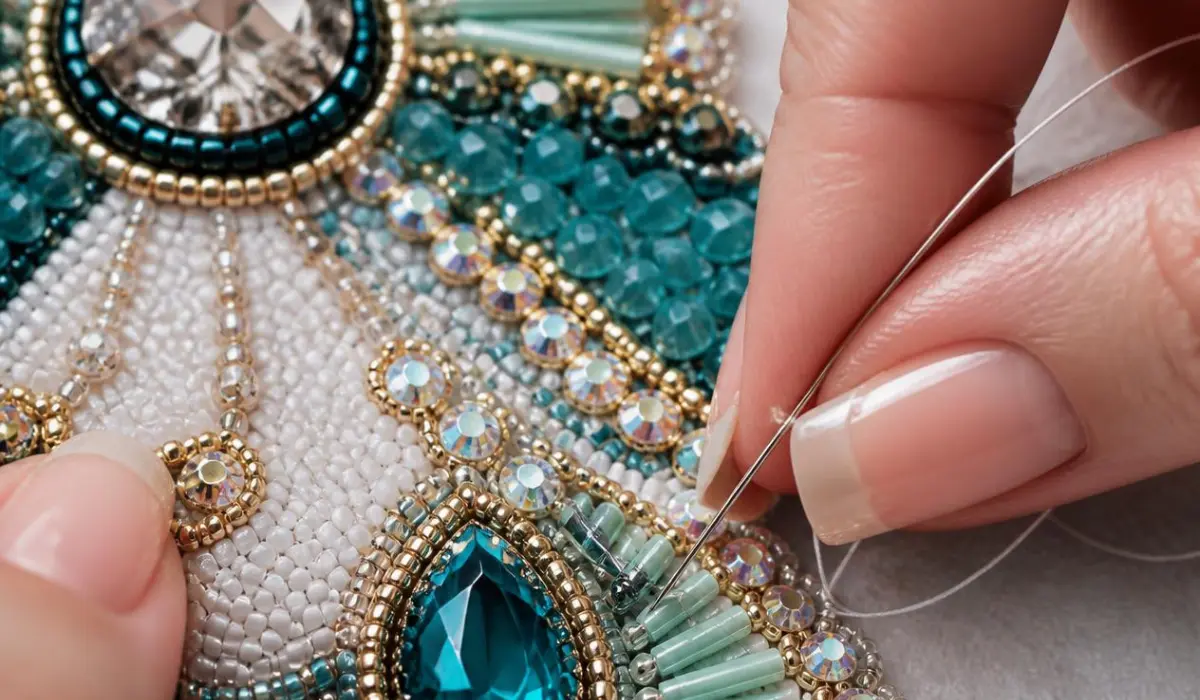
Beaded appliqué on a peyote base means you first make a tight pattern using peyote stitch, then sew extra beads or decorations on top. The peyote base works like a strong beaded cloth that holds everything in place without glue.
If you add beads on loose fabric, they can sag or move. But with a peyote base, the beads stay firm and neat, so your design looks better and lasts longer.
Table of Contents
What Is a Peyote Base, Exactly?
A peyote base is a piece of beadwork made using peyote stitch, one of the most common off-loom weaving techniques. Beads are stitched in an up-down, brick-like pattern using a single needle and thread, with no loom required.
Once woven, a peyote base behaves like a dense, flexible beaded textile. It can be:
- Flat peyote – a solid rectangle, circle, or custom shape
- Tubular peyote – a hollow cylinder, often used for bezels or bracelet cores
- Circular/flat peyote rounds – used for medallions and cabochon settings
This base is what you applique onto — adding fringe, crystals, seed bead clusters, or bugle beads directly into the existing bead holes or thread paths.
Why Use a Peyote Base for Appliquee Instead of Fabric?
| Peyote Base | Fabric Base |
|---|---|
| Beads anchor into existing beadwork — very secure | Beads anchor into fabric weave — can loosen over time |
| No backing or interfacing needed | Usually needs stabilizer or felt backing |
| Naturally flexible and drapes like fabric | Depends on fabric weight |
| Best for standalone beaded pieces (cuffs, medallions, bezels) | Best for garments and larger surface areas |
If your project is a bracelet cuff, pendant, or beaded medallion, a peyote base almost always outperforms fabric. If you’re appliqueing beads across a large garment panel, fabric is usually more practical — this is where the two techniques serve different purposes rather than competing.
Materials You’ll Need
- Delica or Miyuki seed beads (size 11/0 works well for a peyote base)
- Beading needle (size 10–13)
- Nylon beading thread (Fireline or KO thread — avoid weak cotton thread)
- Bead embellishments for applique: crystals, bugle beads, pearls, or contrast seed beads
- Beeswax or thread conditioner (optional, but reduces tangling)
- Scissors and a bead mat to stop beads rolling away
Step-by-Step: Weaving the Peyote Base First
- Decide your shape and size. Sketch the finished applique panel dimensions before you start — peyote stitch is hard to resize mid-project.
- String your first two rows. Add an even number of beads for standard even-count peyote.
- Begin the peyote pattern. Stitch each new bead into the “valley” between two beads from the previous row, working back and forth.
- Keep tension consistent. Loose tension is the single biggest cause of a wobbly, uneven base — pull thread snug after every few beads, not just at the end of a row.
- Weave until your base is the right size, then secure the thread with several half-hitch knots woven back through nearby beads.
Step-by-Step: Adding the Beaded Applique
- Thread a new length of thread and knot it into the peyote base (neever start a fresh thread with a loose end on top).
- Bring the needle up through an existing bead in the peyote base — this is your anchor point.
- Pick up your applique beads (a crystal, a small cluster of seed beads, a bugle bead) and stitch back down into a nearby bead in the base.
- Repeat in a pattern, moving row by row or following a marked design. Keep the applique beads snug against the base surface so nothing floats loosely.
- Reinforce heavy embellishments (like large crystals) by passing the thread through them twice for extra hold.
- Finish and weave in all thread tails the same way you finished the base — several small locking stitches, then trim close.
Common Mistakes Beginners Make
- Using thread that’s too thin. Applique adds extra weight; thin thread snaps under stress. Fireline or a heavier nylon thread holds up much better.
- Skipping tension checks. A loose peyote base will show gaps once applique beads are added on top — check tension row by row, not after finishing.
- Overloading one area with heavy beads. Large crystals clustered together can warp a flat peyote base. Spread weight evenly, or reinforce that section with extra thread passes.
- Not anchoring applique stitches into multiple base beads. Stitching into just one bead repeatedly weakens that bead’s hole over time. Rotate anchor points.
- Starting applique before the base is fully secured. Always knot and weave in the base thread first — never leave it dangling “to finish later.”
Tips From Practical Experience
- Work under strong, direct light — peyote patterns are easy to misread in dim lighting, and a single dropped stitch early on throws off the whole base.
- Lay out your applique beads on the mat in the pattern order before stitching, so you’re not second-guessing placement mid-row.
- If a project will get regular wear (bracelet, bag strap), test the finished panel by gently flexing it before calling it done — any beads that feel loose need reinforcing now, not after they’ve fallen off.
- Smaller peyote bases (under 2 inches) are much more forgiving for a first attempt than large panels — practice control before scaling up.
FAQ
Do I need to know peyote stitch before trying beaded applique?
Yes, at least the basics. Beaded applique on a peyote base assumes you can weave a stable flat or tubular peyote panel first, since that panel becomes the surface everything else is stitched onto.
Can I use peyote stitch applique on clothing?
Yes, but it’s better suited to smaller accent pieces (collars, cuffs, patches) rather than large areas, since a woven peyote panel is denser and heavier than fabric applique.
What thread works best for this technique?
A strong nylon beading thread like Fireline or KO thread. Regular sewing thread or cotton thread wears out quickly under the extra stress of applique beads.
Why do my applique beads keep coming loose?
Usually it’s one of two things: the anchor stitches aren’t passing through enough base beads, or the tension on the original peyote base was too loose to begin with. Reinforcing anchor points and rechecking base tension fixes most cases.
Can beginners really do this, or is it an advanced technique?
It’s an intermediate technique. If you’re comfortable with basic peyote stitch, adding applique is a natural next step — just start small and keep tension consistent.