
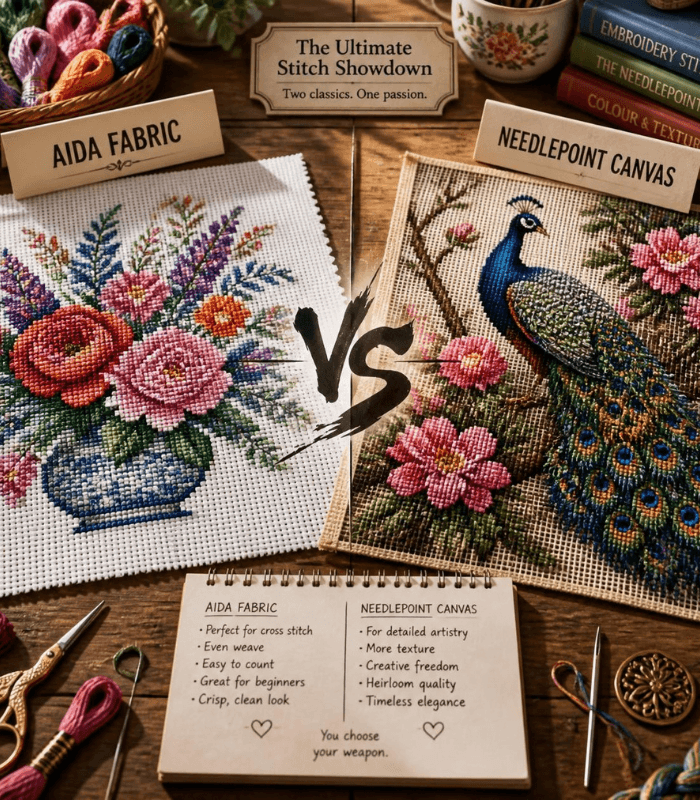
People often ask me which fabric is “better” between Aida and needlepoint canvas, and the honest answer is that they’re not really competitors. They’re built for two different crafts that simply happen to look related from across a room.
Aida cloth is a cotton fabric woven into visible, evenly spaced blocks, and it’s the standard surface for cross stitch. Those blocks exist for a reason — each one gives you a clear, countable spot to place your X, which is why cross stitch charts are designed around Aida’s block structure in the first place. Aida is soft, drapes well, and can be framed, sewn into towels, or turned into ornaments without much extra effort. I remember exactly how much easier stitching felt once I moved from a rough practice scrap to a properly sized 14-count piece — the fabric almost tells your needle where to go.
Needlepoint canvas is the opposite kind of material: stiff, open-mesh, usually cotton or a cotton-poly blend, and designed to be completely covered in stitches, background included. There’s no resting fabric peeking through in finished needlepoint the way there often is in cross stitch. That’s a genuinely different philosophy — cross stitch decorates a fabric surface, while needlepoint transforms the entire canvas into a dense, tapestry-like textile.
The stitch vocabulary reflects that split. Cross stitch is built almost entirely around a single X stitch, worked over Aida’s printed blocks. Needlepoint uses dozens of stitch families — tent, basketweave, continental, and a long list of decorative textured stitches — because open canvas gives thread room to angle and layer in ways tightly woven Aida simply doesn’t allow.
I’ve had people hand me a needlepoint canvas asking why their cross stitch pattern won’t line up, and the answer is almost always the same: they’re trying to force a chart built for one material’s math onto a completely different grid. A cross stitch pattern is measured in Aida block counts; a needlepoint pattern is measured in mesh count, and the two don’t translate without reworking the numbers from scratch.
If you’re genuinely torn between them for a project, the real question isn’t which fabric is superior — it’s whether you want the lighter, more flexible finish cross stitch produces, or the plush, fully saturated texture that comes from needlepoint. That’s a question about the final object you want to hold, not about which craft is harder or more legitimate. Once you frame it that way, the choice usually makes itself, and you stop treating two very different textile traditions as if they’re rivals competing for the same drawer in your craft supplies.