
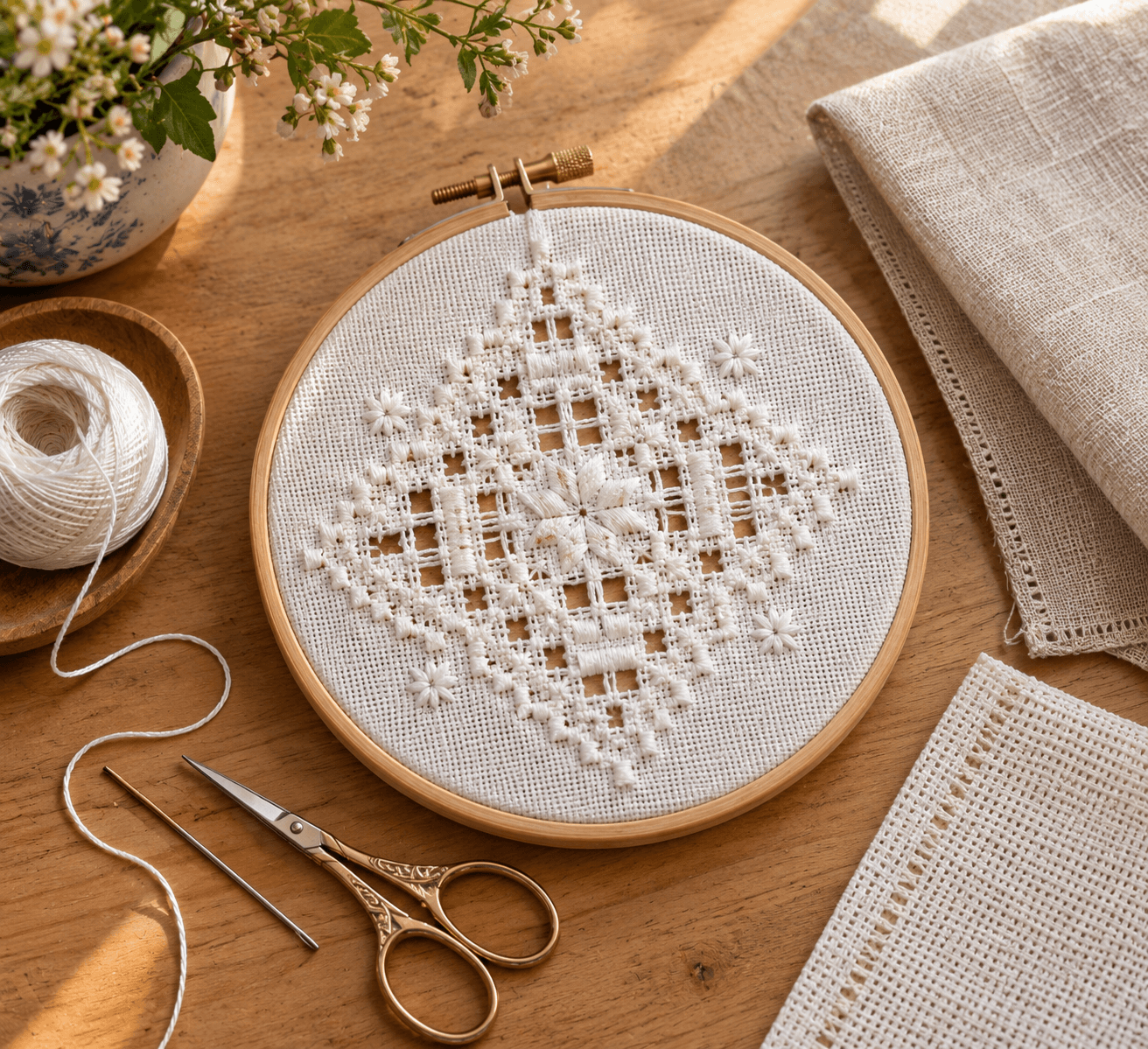
Hardanger embroidery needs an evenweave fabric, meaning the same number of threads run in both directions. For most beginners, that means 22 count cotton Hardanger cloth. Stitchers who want a finer look often move to evenweave linen later.
I learned this the slow way. My first Hardanger project went wrong, and the fabric was the reason.
My First Mistake
I started on a soft, stretchy cloth I already had in my stash. It looked fine. Then I cut between my kloster blocks, and the whole area sagged and frayed. I had stitched for hours on a fabric that could not hold its shape.
That is the thing about Hardanger. You are not only decorating the cloth. You are cutting parts of it away. The fabric has to stay firm, even and clean after the scissors have been through it.
What Is Hardanger Cloth?
Modern Hardanger cloth is a cotton evenweave woven with pairs of threads. It has about 22 pairs per inch in both directions, which is why you will see it labelled “22 count.” Some shops sell it as Oslo fabric.
The paired threads leave clear gaps. You can see where your needle goes and which threads to cut. When I switched to it, my counting mistakes dropped almost overnight.
Why I recommend it for beginners:
- The threads are easy to count, even in weak light
- It stays firm after cutting
- Most beginner charts and kits are written for 22 count
- It is cheap enough that mistakes do not sting
What Did Stitchers Use Traditionally?
Cotton Hardanger cloth is not the traditional fabric, though many people think so. Historic Hardanger was worked on fine linen evenweave, around 36 count or higher, with linen thread in white or cream. One researcher who studied old pieces in Norwegian museums reports counts between about 35 and 55.
So 22 count cloth is a modern convenience. That is perfectly fine. You do not need to feel guilty for choosing it, or for choosing linen.
Can You Use Other Fabrics?
Yes. Any smooth evenweave in linen, cotton or a blend can work, at any count, as long as you can count and cut it cleanly. Bellana (20 count) is roomy for learners, and Lugana (25 count) gives a finer look.
I later tried 28 count evenweave and loved the result. Linen was lovelier still, but harder. The threads are smaller and slightly uneven, and I needed a bright lamp. Move up gradually: 22 count first, then 25 or 28, then linen.
Match Your Thread to Your Fabric
Perle cotton is the usual thread. On 22 count, use #5 for the satin stitch blocks and #8 for the fillings. On finer fabrics of 25 count and above, use #8 and #12. Thread that is too heavy crowds the blocks, and thread that is too light looks weak.
What to Avoid
Aida cloth. It is made for cross stitch, and its bundled threads do not cut cleanly for Hardanger.
Loose or stretchy weaves. Like my first attempt, they sag once cut.
Uneven fabric. Hold it up to the light before buying. Thick and thin patches make counting a headache.
Tools That Matter
- Blunt tapestry needles, so you do not split the fabric threads
- Very sharp, small embroidery scissors. Dull ones chew the threads, and I will never skimp here again
- A hoop, taken off before cutting
Quick FAQ
What is the best fabric for Hardanger beginners?
22 count cotton Hardanger cloth.
Can I use linen?
Yes. It is closer to the traditional fabric, but harder to count, so try it after a few projects.
Can I use Aida?
I would not. Choose evenweave instead.
Final Thoughts
So, what kind of fabric is used for Hardanger embroidery? Any firm, smooth evenweave works, but 22 count cotton Hardanger cloth is the best place to start. Learn your stitches there, then move to finer fabric when you feel ready. And always count twice before you cut.
About the Author: Sara McLean is the creator of AppliquéFits.com and a textile designer who shares practical appliqué, sewing, and fabric-design ideas.