

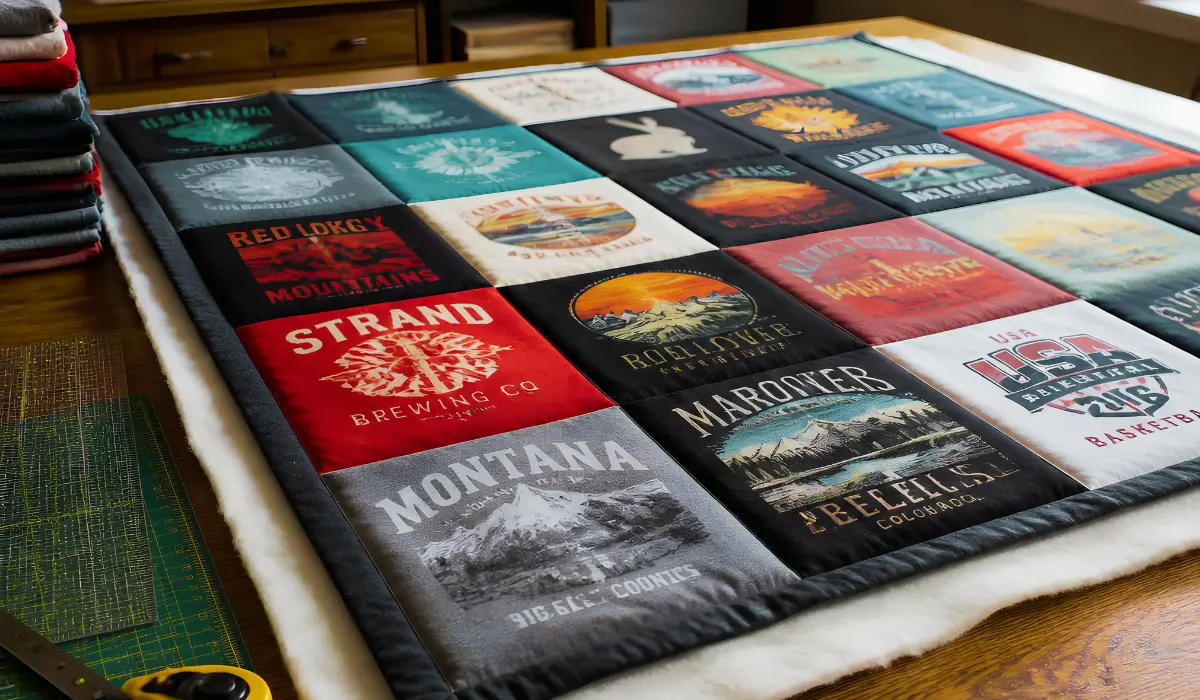
A t-shirt quilt turns a box of old concert tees, sports jerseys, and graphic shirts into something you’ll actually use again, and batting is what gives it real warmth and body instead of just being a stitched-together stack of squares. The process differs a bit from a standard cotton quilt, mostly because knit fabric behaves nothing like woven quilting cotton, so it needs extra stabilizing before it ever meets your batting and backing.
I’ve made more of these than I can count, both for myself and for students clearing out closets full of shirts they can’t bear to throw away but never wear. It’s one of my favorite projects to teach, because the sentimental value makes people care about getting it right.
Table of Contents
Why T-Shirt Fabric Needs Special Handling
Regular quilting cotton is woven and holds its shape. T-shirts are knit, which means they stretch, curl at the edges, and shift under a sewing machine needle if you don’t stabilize them first. Skip this step and you’ll end up with wavy blocks, puckered seams, and a top that doesn’t lie flat no matter how well you quilt it.
What You’ll Need
- T-shirts (as many as you want in your finished quilt)
- Fusible interfacing, lightweight to medium weight
- Cotton sashing fabric to frame each t-shirt block
- Batting, cut a few inches larger than your finished top
- Backing fabric
- Curved safety pins or basting spray
- Walking foot for machine quilting
- Rotary cutter, ruler, and cutting mat
Steps to Make a T-Shirt Quilt with Batting
1. Stabilize Each Shirt
Cut the front (and back, if using both) off each shirt, then fuse lightweight interfacing to the wrong side. This single step keeps knit fabric from stretching and warping once you start cutting and sewing.
2. Cut Your Blocks to a Consistent Size
Pick one block size for the whole quilt and trim each stabilized panel to that size using a rotary cutter and ruler. Centering graphics as you cut keeps the design looking intentional rather than random.
3. Add Sashing Between Blocks
Sew strips of cotton sashing between and around each block. Sashing frames each design and adds structural stability, since knit fabric alone doesn’t hold seams as well as woven cotton.
4. Assemble the Quilt Top
Piece your sashed blocks into rows, then sew the rows together. Press seams open or to one side as you go so everything lies flat before layering.
5. Layer with Batting and Backing
Build your quilt sandwich the usual way: backing right-side down, batting in the middle, top right-side up on top. Smooth out wrinkles as you go, working from the center outward.
6. Baste Thoroughly
Pin every 4 to 5 inches or use basting spray. T-shirt quilts tend to be heavier and bulkier at the seams than an all-cotton quilt, so generous basting matters even more here.
7. Quilt Through All Three Layers
A walking foot helps enormously, since it feeds the thicker seam intersections evenly instead of letting them bunch under the needle. Straight-line quilting or a basic grid works well and won’t compete with the busy graphics.
8. Trim and Bind
Once quilting is finished, trim the excess batting and backing, then finish the raw edges with binding for a clean, durable edge.
Choosing the Right Batting
A medium-loft cotton-poly blend batting is a popular choice for t-shirt quilts, since it adds warmth without making the already-thick seam intersections harder to quilt through. Very high-loft battings can be tough to manage given how much bulk t-shirt seams already add.
Common Mistakes to Avoid
- Skipping interfacing, which leads to stretched, wavy blocks that never sit flat.
- Cutting blocks to different sizes, making final assembly uneven and frustrating.
- Choosing a batting that’s too thick for the seam bulk t-shirt quilts already have.
Tips for Better Results
- Sort your shirts by fabric weight before cutting; thin or worn shirts may need slightly heavier interfacing.
- Keep sashing fabric consistent in color and weight so the eye moves smoothly from block to block.
- Wash and dry your shirts before cutting, since pre-shrinking now avoids surprises later.
FAQ
Do t-shirt quilts need interfacing?
Yes, almost always. Interfacing stabilizes the stretchy knit fabric, which keeps blocks from warping during cutting, piecing, and quilting.
What batting works best for a t-shirt quilt?
A medium-loft cotton-poly blend is a common choice, since it adds warmth without piling extra bulk onto the already-thick seam intersections.
How many t-shirts do I need for a full quilt?
It depends on your block size and quilt dimensions, but a lap-sized quilt typically uses somewhere around 20 to 30 shirts.
Can I mix t-shirts with regular quilting cotton?
Yes, sashing between t-shirt blocks is usually cotton, and mixing woven cotton borders with knit centers is standard practice.
Is a t-shirt quilt harder to make than a regular quilt?
It has an extra stabilizing step that regular cotton quilts don’t need, but the piecing and quilting process afterward is very similar.
Written by Sara McLean, Textile & Appliqué Specialist — 12+ years quilting experience