

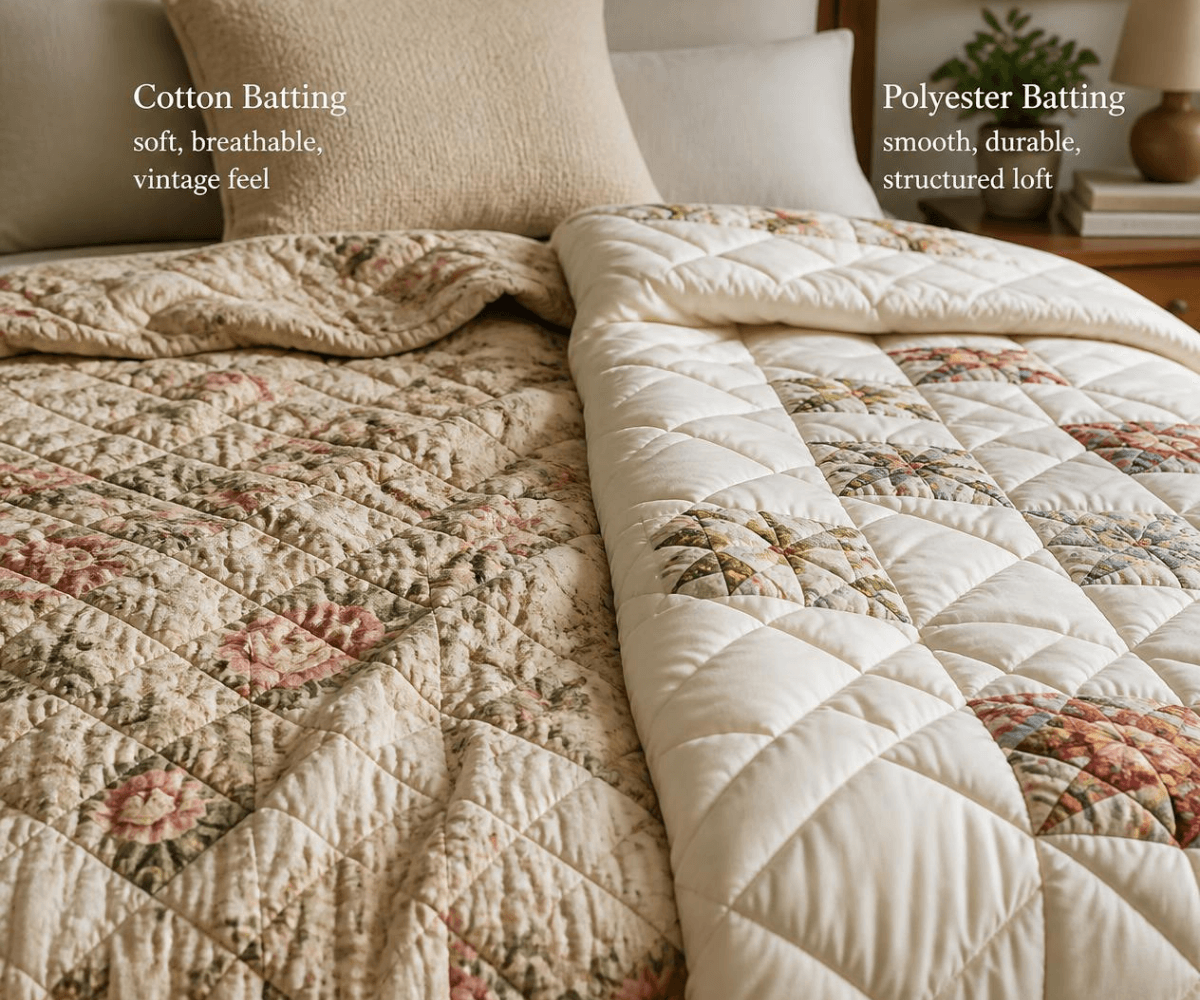
Cotton batting gets the reputation. It’s the one quilters describe in reverent, heirloom-adjacent terms — breathable, traditional, the stuff that ages into that soft, crinkled look everyone associates with an “old quilt.” Polyester batting gets talked about like a compromise. Cheaper, sure, but somehow less serious. That reputation is mostly inherited and mostly outdated, and it’s worth asking why a material this practical still has to apologize for itself.
Table of Contents
The actual case for it
Start with the numbers nobody argues about: polyester batting shrinks at less than 1%, which means the pre-washing ritual that governs cotton batting simply doesn’t apply here. No shrinkage math, no test swatches, no guessing how a quilt will pucker after its first trip through the dryer. What you baste is what you get, permanently. That single property does more to explain polyester’s popularity than any marketing copy could — it removes an entire category of risk from a project that already has plenty.
It also solves for durability in a way cotton doesn’t try to. Polyester batting is the default recommendation for quilts that will be washed often and hard — kid quilts, pet blankets, anything headed for genuinely rough use — because it holds up to frequent washing without the shrink-and-distort problem cotton is prone to. It’s also, notably, the batting quilters reach for when a project is bound for a longarm machine at the thinnest available loft: cotton’s lowest lofts don’t perform on a longarm the same way, but polyester’s do, which makes it a practical default rather than a budget one for a meaningful slice of the quilting world.
Where it earns its bad reputation
The knock against polyester is real, not manufactured. Bearding — the tendency for polyester fibers to migrate through the weave and surface as a faint fuzz on the quilt’s exterior — is a documented, recurring complaint, and it’s the reason experienced quilters recommend a tightly woven top fabric specifically to contain it. It’s also prone to shifting inside the quilt when the stitching isn’t dense enough to anchor it, which cuts against one of its supposed advantages: low-loft polyester is marketed as needing less quilting than cotton, but skip too much of that quilting and the batting migrates unevenly instead of staying put.
Then there’s heat. Polyester doesn’t breathe the way cotton or wool does, and a quilt built on it runs warmer — sometimes uncomfortably so — which is exactly why suppliers steer quilters toward flatter, lower-loft polyesters like Thermore for anything that isn’t explicitly meant to be a heavy winter piece. The same trait that makes polyester the right call for a cold-climate bed quilt makes it the wrong call for a summer throw.
The loft question, and why it’s really a taste question
Polyester’s defining trait, more than warmth or durability, is that it comes in real extremes. Cotton batting tends to cluster in a narrower loft range; polyester ranges from needle-flat, fused low-loft batts built for baby quilts and hand stitching, up through genuinely puffy, high-loft options designed for tied quilts and anyone who wants their quilting stitches to read as dimensional rather than subtle. That range is the actual argument for choosing polyester over cotton on a specific project — not durability, not cost, but the fact that if you want a quilt to look architecturally puffy, polyester is the material built to do it, and cotton mostly isn’t trying to.
That range also explains why so many quilters don’t pick a side at all. A common workaround among longarmers and hobbyists alike is a doubled batt — cotton on the bottom for weight, drape, and that traditional crinkle after washing; polyester on top for the loft and the crease resistance that keeps a folded quilt from creasing permanently. It’s not indecision. It’s using each material for the one thing it actually does better than the other.
Who it’s not for
There are real holdouts, and they’re not being precious about it. Quilts destined for hospitals, and specifically for children’s medical facilities, sometimes come with an explicit request for cotton or cotton-blend batting rather than 100% polyester — a preference that shows up often enough in charity-quilting circles that experienced donors keep both battings stocked rather than assuming one will do. Heirloom-intent quilts skew the same direction, for reasons that are more aesthetic than technical: the flat, stable, crease-resistant finish polyester delivers is precisely the opposite of the soft, worn-in unevenness that reads as “antique” on a cotton quilt decades from now.
None of that amounts to polyester being the lesser material. It amounts to polyester being a different one, suited to a different job — the quilt that needs to survive a toddler, a dog, and a decade of washing machines, rather than the quilt meant to look like it’s already survived one. Treating “traditional” as a synonym for “correct” is exactly the assumption polyester batting keeps quietly disproving, one durable, unshrunk, thoroughly modern quilt at a time.
 Minty Mellon