

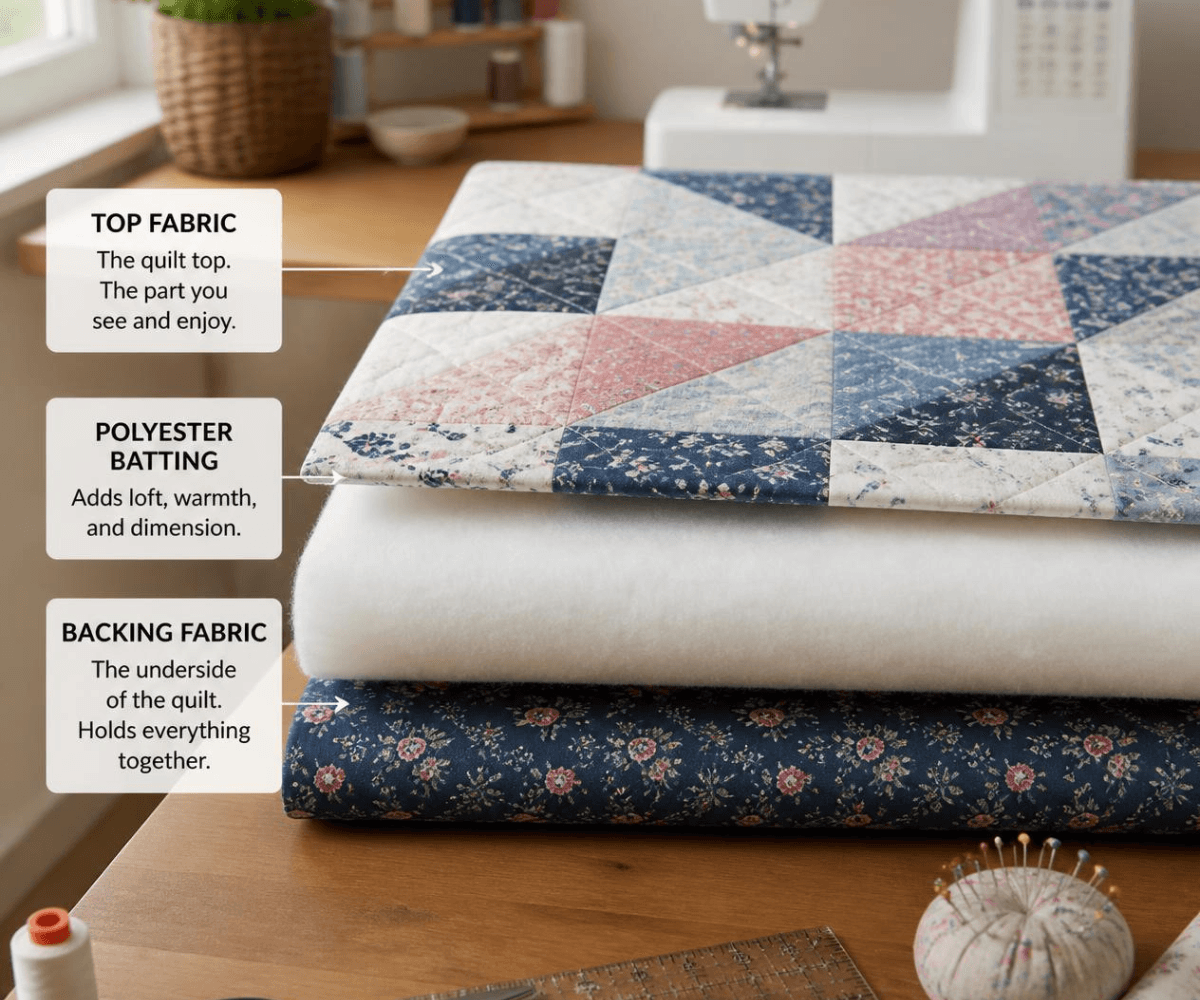
Polyester batting holds its loft after a hundred washes, costs less than cotton per yard, and doesn’t beard through dark fabric the way cheap cotton can. That’s the case for it in three facts, not adjectives — and it’s why quilting with polyester batting remains standard practice for baby quilts, rag quilts, and anything destined for heavy use rather than heirloom preservation.
It isn’t the right batting for every project. Cotton breathes better and drapes flatter; wool holds warmth at a lower weight; silk is reserved for garments and art quilts where loft needs to disappear entirely. Polyester wins on durability and price, and it’s the material most quilters reach for by default — which makes the actual technique worth getting right.
Table of Contents
Is Polyester Batting Good for Quilting?
Yes, with one caveat: low-loft polyester (under 1/4 inch) behaves like cotton and is easy to machine or hand quilt. High-loft polyester (1 inch or more, the kind used in comforters) is harder to control under a domestic machine and better suited to tied or hand-tacked quilts rather than dense machine quilting.
Polyester vs. cotton batting comes down to three differences that actually matter in use:
- Warmth-to-weight: polyester traps more heat per ounce, which is why it’s common in outdoor and camping quilts.
- Drape: cotton batting flattens and softens with washing; polyester stays lofted and slightly stiffer.
- Bearding: cheaper polyester fibers can migrate through loosely woven fabric and show as white fuzz on the surface — a needle-punched or bonded polyester avoids this, a loose polyester fill does not.
If the project is a baby quilt or rag quilt that will be washed weekly, polyester’s durability outweighs cotton’s softer drape. If it’s a bed quilt meant to be kept for decades, cotton or a cotton-poly blend ages better.
How to Quilt with Polyester Batting
The technique differs from cotton in exactly one respect: pinning density. Polyester’s loft means it shifts more inside the sandwich than flatter cotton batting, so basting needs to be tighter — pins or basting stitches every 3 to 4 inches instead of the 4 to 6 inches that’s fine for cotton.
Beyond that, the layering process is standard: backing right-side down, batting centered on top, quilt top right-side up, smoothed from the center outward before basting.
Using Polyester Batting in Quilting: Machine vs. Hand
Machine Quilting with Polyester Batting
Low-loft polyester runs through a domestic machine the same as cotton batting — a walking foot for straight-line quilting, free-motion for curves, standard tension. The one adjustment: polyester’s slight loft can cause more drag under the foot than cotton, so a slightly looser top tension (test on a scrap sandwich first) prevents puckering on the back.
High-loft polyester should not be machine quilted with dense stitching. The loft compresses unevenly and the quilt loses its puffiness in exactly the areas that got quilted — tying or hand-tacking preserves the loft better.
Hand Quilting with Polyester Batting
Hand quilting through polyester takes more force per stitch than cotton because the fibers resist compression more. Low-loft polyester hand-quilts comparably to cotton with a slightly heavier hand; high-loft polyester is difficult to hand-quilt with a traditional running stitch and is better suited to hand-tying (see below) than a fine quilting stitch.
How Far Apart to Quilt with Polyester Batting
Quilting distance is a function of the batting’s stated maximum, not a fixed rule. Needle-punched polyester batting typically lists a maximum quilting distance of 8 to 10 inches on the bag — meaning no point on the quilt should be more than that far from a line of stitching or a tie, or the batting will shift and bunch inside the quilt over time. Bonded, high-loft polyester (like the kind used in comforters) often allows up to 10 to 12 inches. Always check the manufacturer’s number on the packaging; it varies by brand and construction, and quilting closer than the maximum is always safe — quilting further apart is not.
Quilting with 2 Layers of Batting
Doubling batting — two layers of low-loft polyester, or one layer each of cotton and polyester — is a real technique used to boost warmth or loft without switching to a single high-loft batting that’s harder to quilt through. It works, with two practical notes: basting needs to be even tighter (every 2 to 3 inches) because two loose layers shift independently, and machine quilting through two layers requires a longer stitch length and often a heavier needle (a 90/14 or 100/16) to punch through the added thickness without skipped stitches.
Blocking a Quilt with Polyester Batting
Blocking — wetting and pinning a quilt flat to square it up — works differently with polyester than cotton. Cotton batting absorbs water and can be blocked wet, the way you’d block a knit. Polyester batting is largely water-resistant and doesn’t reshape the same way when damp; instead, the top and backing fabric do the actual reshaping while the polyester batting underneath stays inert. Steam-block from the fabric side with a pressing cloth rather than soaking the quilt, and pin it flat to dry on a surface that won’t be damaged by residual moisture.
Can You Make a Rag Quilt with Polyester Batting?
Yes — flannel is the traditional rag quilt filler because it frays cleanly at the seams, but a thin, low-loft polyester batting works as a substitute when more loft or warmth is wanted. It fringes less cleanly than flannel at the cut edges, so seam allowances often need to be slightly wider (1 inch instead of the standard 3/4 inch) to compensate. For a full walkthrough on cutting, layering, and fraying technique, see our dedicated rag quilt tutorial.
General Batting Basics
What batting to use for quilts ultimately depends on three questions: how the quilt will be used (decorative vs. daily), how it will be washed (gentle vs. machine), and what look is wanted (flat and traditional vs. puffy and modern). Polyester answers “durable, washable, and a little puffier” — which covers most quilts made for actual use rather than display.
How to quilt as you go with batting — a technique where each block is quilted individually before assembly rather than quilting the whole top at once — works with polyester the same as cotton, though the batting should be trimmed slightly smaller than the block to avoid bulk in the joining seams.
FAQ
Can you quilt with just batting on the back — no separate backing fabric?
No. Batting alone isn’t stable enough to serve as a backing; it will pill, wear through, and separate from the top without a woven or knit backing fabric behind it.
Can you quilt with minky without batting?
Minky’s plush pile adds enough loft on its own that some low-profile projects (like baby blankets) skip batting entirely and rely on minky backing plus a cotton top. For anything meant to be quilted with visible stitch texture, batting is still needed to create the loft the stitching sits into.
What batting works best with a flannel quilt?
Low-loft cotton or polyester, both of which quilt cleanly through flannel’s texture without adding excess bulk. High-loft batting under flannel tends to look overstuffed rather than cozy.
 Minty Mellon