

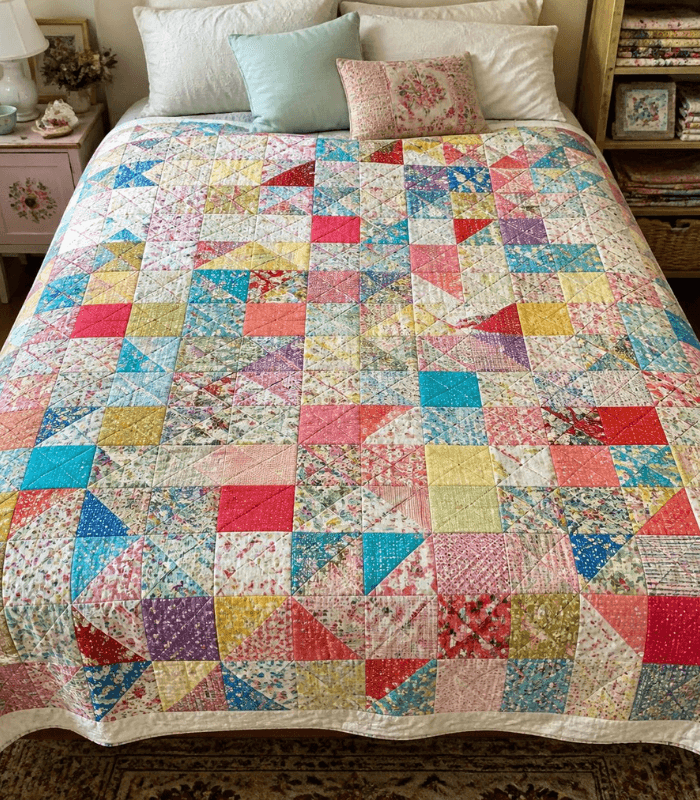
I’ve made scrappy quilts from decades-old inherited fabric, from scrap swaps with other quilters, and from my own leftover fat quarters that had been sitting untouched for years. Every one of them has come together differently, because no two scrap piles are ever the same. That unpredictability used to make me nervous. Now it’s exactly why I keep coming back to this pattern — it forces decisions a coordinated fabric line never asks me to make.
Table of Contents
What You’ll Need
- A wide mix of fabric scraps, sorted loosely by color or print
- A consistent background or setting fabric, if you’re using one
- A rotary cutter, ruler, and mat
- A design wall or clear floor space
- Batting
- Backing fabric
- Quilting thread
How I Piece Mine Together
- Sort your scraps into light, medium, and dark value groups before doing anything else.
- Choose one fixed variable to unify the quilt — a single background fabric, a consistent block size, or a shared color family.
- Cut your pieces according to your chosen block pattern, pulling from your sorted value groups.
- Piece a handful of test blocks first and lay them side by side to check the balance.
- Continue piecing blocks in batches, checking values as you go rather than all at the end.
- Lay every finished block out on a design wall before sewing rows together.
- Rearrange as needed until no single fabric or color clumps in one area.
- Sew the blocks into rows, then join the rows to form your quilt top.
- Layer, baste, quilt, and bind to finish.
A Few Lessons From My Quilting Table
- Sorting by value before cutting anything is the one step that makes a scrappy quilt look intentional instead of chaotic.
- Fixing one variable — like a shared background fabric — gives a scrappy quilt enough structure to hold together visually.
- A scrap swap with other quilters is the easiest way to break out of your own default color habits.
- Laying blocks out before sewing rows catches clumping and repetition that’s hard to see fabric by fabric.
Mistakes I’ve Made Along the Way
- My first scrappy quilt looked muddy because I skipped sorting by value and just grabbed whatever was on top of the pile.
- I once used only fabrics from my own stash and ended up with a quilt that looked suspiciously coordinated instead of genuinely scrappy.
- Cutting scraps as I went, instead of prepping them in batches, slowed me down far more than it needed to.
Questions I Get Asked
Do scrappy quilts need to match at all?
Not in color, but they do need to agree in value. That’s what keeps a mix of unrelated fabrics from reading as visual noise.
How many different fabrics do I actually need?
There’s no fixed number, but I generally aim for at least fifteen to twenty for a lap-size quilt to get a genuinely scrappy look.
Can I turn a leftover fabric stash into a scrappy quilt?
Yes, and it’s one of the best uses for it. Inherited or mismatched stashes rarely work in a coordinated quilt, but they’re perfect here.
What’s the easiest scrappy pattern for a first attempt?
A simple scrappy nine-patch or square-in-a-square block is forgiving and lets you focus on sorting and balance rather than tricky piecing.
How much fabric do I need for a scrappy lap quilt?
For a lap quilt around 50″ x 60″, I’d plan on roughly 3 to 4 yards total across all your scraps combined, plus background fabric if you’re using one.
By Sara McLean