

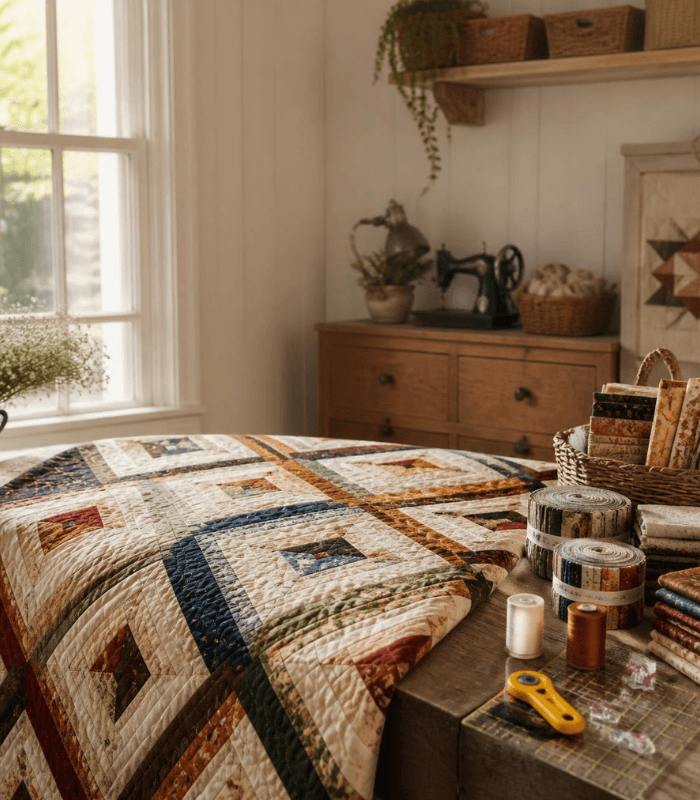
I’ve made log cabin quilts for housewarmings, for guild challenges, and once as a quiet, meditative project during a stretch when I needed something repetitive to work through with my hands. Every block is built the same way — strips added in rounds around a center square — so once you’ve sewn one, you understand the whole quilt. What keeps it interesting is that the same simple block can produce a completely different secondary pattern depending on how you arrange it.
Table of Contents
What You’ll Need
- A center-square fabric (traditionally red)
- Assorted light and dark strips, or a jelly roll bundle
- A rotary cutter, ruler, and mat
- A design wall or clear floor space
- Batting
- Backing fabric
- Quilting thread
How I Piece Mine Together
- Cut your center squares and your light and dark strips to a consistent width.
- Sew your first light strip to one side of the center square, then trim it flush.
- Rotate the block and add the next light strip along the adjacent side.
- Switch to dark strips and continue rotating and adding, working outward in rounds.
- Press seams outward after each strip to keep the block flat as it grows.
- Repeat until your block reaches the finished size you want.
- Make all your blocks first, then lay them out on a design wall before sewing anything together.
- Arrange the blocks into your chosen layout — Barn Raising, Straight Furrow, or another variation.
- Sew the blocks into rows, then join the rows to form your quilt top.
- Layer, baste, quilt, and bind to finish.
A Few Lessons From My Quilting Table
- Laying every block out before sewing rows together is the only reliable way to catch a value mismatch before it’s permanent.
- Chain-piecing the strips as you build each block saves a real amount of time across a full quilt.
- Pressing seams outward, away from the center, keeps the block flatter than pressing them all one direction.
- A jelly roll bundle removes almost all the guesswork from strip width, which is genuinely useful on a first attempt.
Mistakes I’ve Made Along the Way
- I once used a “light” fabric that was actually medium-value under my studio lighting, and it broke the diagonal pattern across the entire top.
- Skipping the design-wall step early on meant I didn’t notice a color problem until half the quilt was already sewn.
- Inconsistent strip widths from block to block made my rows uneven and harder to join cleanly.
Questions I Get Asked
What size should a log cabin block be?
I usually build mine to 12″ finished, though a single oversized block can work well on its own as a pillow front or wall hanging.
Do I need a longarm machine to quilt one of these?
Not at all. A home machine handles straight-line quilting well, and log cabin tops are simple enough that hand quilting is a good option too.
What’s the difference between Barn Raising and Straight Furrow?
Barn Raising creates concentric diamonds radiating from the center of the quilt, while Straight Furrow uses the same blocks to form diagonal stripes instead.
Can I use a jelly roll for a log cabin quilt?
Yes, and it’s one of the best uses for one — the pre-cut strip width matches this pattern’s construction almost perfectly.
How much fabric do I need for a lap-size log cabin quilt?
For a lap quilt around 50″ x 60″, I’d plan on roughly 3 to 4 yards total across your light, dark, and center fabrics.
By Sara McLean