

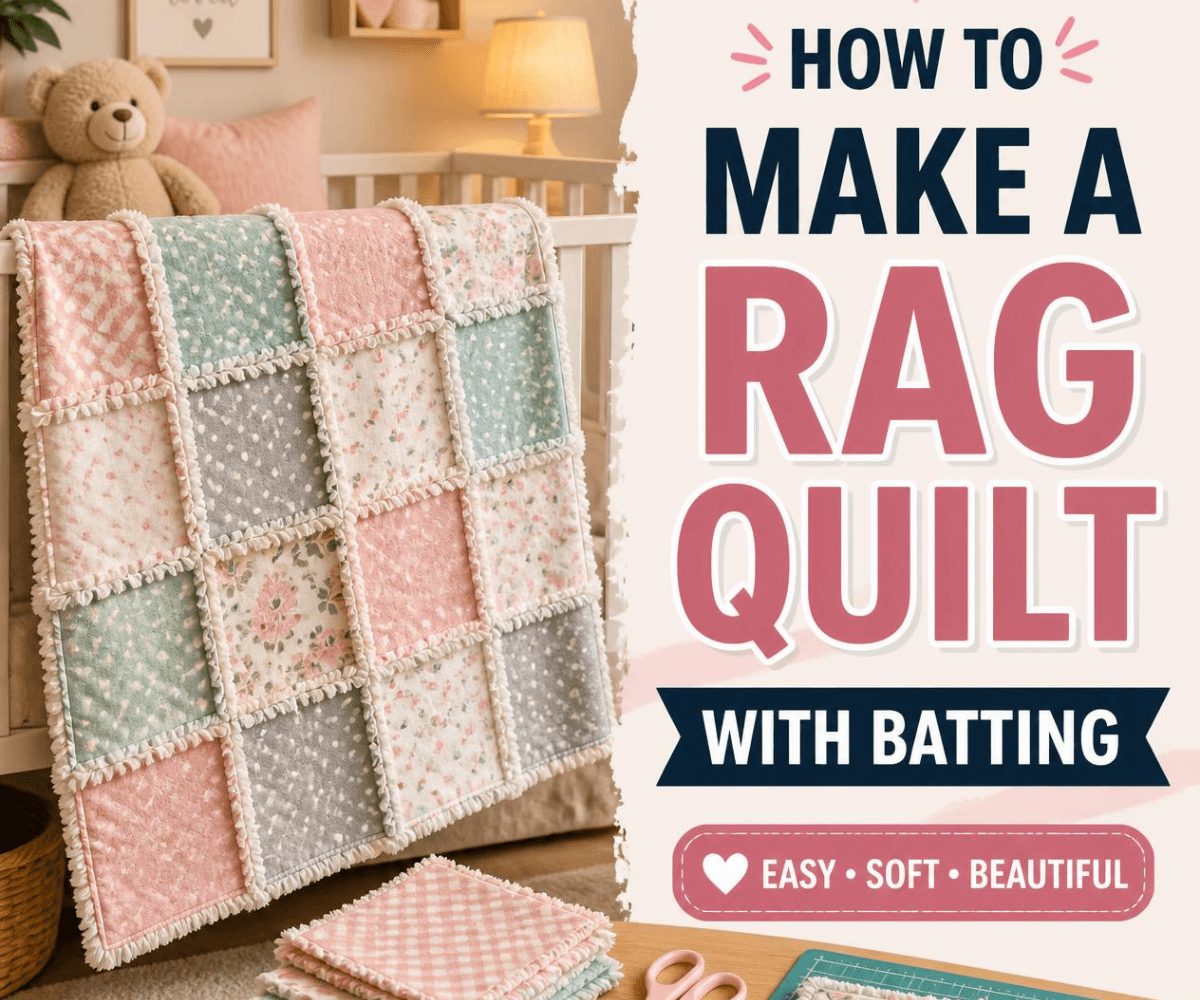
A rag quilt is built inside-out: seams sit on the front, not hidden in the back, and get clipped so they fray into a soft fringe with washing. That single structural difference is what separates it from a standard quilt — no binding, no hand-finishing, and a filler layer that’s chosen for how it frays, not just how it insulates.
Flannel is the traditional filler because it fringes evenly and doesn’t shed excessively. Batting is a common substitute when more loft or warmth is needed, and it works well as long as the seam allowance and clipping technique are adjusted for it.
Table of Contents
How to Make a Rag Quilt with Batting
Materials: cotton squares for the front, a coordinating or contrasting fabric for the back, and a filler layer — flannel, cotton batting, or a low-loft polyester batting, cut to the same size as the front and back squares.
Seam allowance: 3/4 inch to 1 inch, wider than a standard quilt’s 1/4 inch. The extra width is what becomes the fringe.
Assembly:
- Cut front, back, and batting squares to identical dimensions — a common size is 8×8 inches, though any size works as long as it’s consistent.
- Stack each square as front (right side out), batting, and back (wrong side facing the batting) — three layers per unit, sandwiched with the batting hidden between two right-side-out fabrics.
- Quilt an X or crosshatch through each three-layer square before joining, which stabilizes the batting so it doesn’t shift once the quilt is assembled.
- Sew the squares together in rows with the seams facing outward (front side), using the wide seam allowance.
- Join rows the same way, seams facing out.
- Clip into the seam allowances every 1/4 to 1/2 inch, cutting close to the stitch line without cutting through it.
- Wash and dry the finished quilt — the agitation is what raises the fringe. Expect noticeable lint in the dryer on the first few washes; clean the lint trap between cycles.
How to Rag Quilt with Batting vs. Flannel
The core process is identical. The difference is in the clip:
- Flannel frays into a soft, even fringe almost immediately, because it’s a loosely woven fabric to begin with.
- Batting, especially cotton batting, fringes similarly but sheds more fiber in the first wash — expect to clean out the dryer lint trap more than once.
- Polyester batting resists fraying the way woven flannel or cotton does. It doesn’t have a woven structure to unravel, so it tends to pill or mat at the cut edge rather than produce a clean fringe. If a fringed, frayed look is the goal, flannel or a cotton batting outperforms polyester here — polyester is a better fit for warmth and loft than for the visual fray effect.
Rag Quilt with Flannel Batting
Using flannel as the middle “batting” layer instead of true quilt batting is the classic approach, and it’s worth understanding why it’s the default: flannel is a woven fabric, so its cut edges genuinely fray the same way the front and back squares do, giving a uniform fringe texture across the whole seam rather than just at the top and bottom layers.
Cotton Rag Quilt with Flannel Batting
A cotton-front, flannel-middle, cotton-back combination is the most common rag quilt build. All three layers are woven cotton or cotton-blend fabric, so they clip and fray at the same rate — no mismatched texture where one layer frays faster than another.
Denim Rag Quilt with Batting
Denim rag quilts use heavier fabric for the front (often repurposed jeans) and typically pair it with flannel or a thin batting for the middle layer rather than more denim, since three layers of denim is too thick to sew or clip cleanly through a standard machine. The seam allowance for denim rag quilts usually needs to be closer to 1 inch, and a heavier needle (100/16 or a denim needle) is necessary to get through the combined thickness.
How to Make a Baby Rag Quilt with Batting
The technique is the same as above, scaled down. A few adjustments matter specifically for baby quilts:
- Use a lighter filler — thin flannel or low-loft cotton batting, not a thick or high-loft polyester, since bulk and weight matter more for a blanket a baby will be under.
- Prewash all fabrics before cutting. Rag quilts shrink and fray with the first wash regardless of fabric, and for baby items, prewashing also removes any manufacturing residue.
- Round the outer corners slightly before the final wash — sharp fringed corners on a rag quilt can feel scratchy against a baby’s skin, and rounding softens the effect.
- Choose fabrics rated for infant use if the quilt will be in direct, prolonged contact with the baby, and confirm care instructions (batting content especially) meet safety standards for children’s bedding items in your region.
Video vs. Written Instructions
Rag quilt clipping technique — how close to cut, how deep, how evenly spaced — is genuinely easier to absorb by watching than by reading a distance measurement. If this is a first rag quilt, watching one full clipping pass on video before starting is worth the ten minutes; the written seam-allowance and layering steps above translate directly, but the clip itself is a hand-motion skill.
FAQ
Do I need to finish the raw edges before clipping?
No — the raw edges are the entire point. Finishing or serging them would prevent the fray effect that defines a rag quilt.
Why is my quilt not fraying evenly after several washes?
Uneven fray usually means the seam allowance was inconsistent square to square, or the filler layer (especially polyester batting) isn’t a woven fabric and won’t fray the way flannel does. Switching filler to flannel or cotton batting on future projects fixes this; on a quilt already assembled, additional wash cycles and manually pulling loose threads can help even it out.
Can I use a rag quilt technique with regular batting instead of flannel or thin batting?
Standard high-loft batting works but makes for a bulkier, stiffer rag quilt that’s harder to clip through cleanly and harder to sew through multiple stacked seams. Low-loft batting or flannel is easier to manage through the full construction process.
 Minty Mellon