
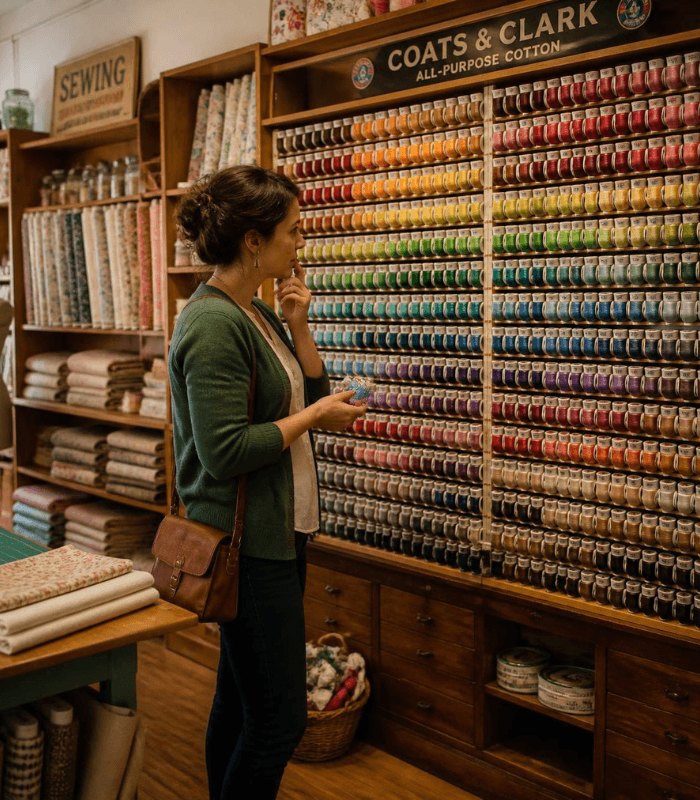
I remember standing in front of my local fabric store’s thread wall in 2012, completely overwhelmed. I was starting my first serious appliqué project and had no idea what I needed. The owner grabbed a spool of Coats & Clark thread and simply said, “This is what I use. Never fails.” Twelve years later, I’m still using Coats and clark thread for most of my sewing work.
That first spool began my relationship with Coats cotton thread, and honestly, it’s saved me countless frustrations. I’ve tried boutique brands, expensive specialty options, and everything in between. But whenever I need something I can trust—whether I’m hand-stitching a detailed appliqué or running fabric through my machine for a quick repair—I reach for Coats & Clark all purpose thread.
Table of Contents
The Feel of Real Cotton
The beauty of pure 100% cotton thread is that it feels right in your hands. Coats all purpose cotton thread has this smooth quality that polyester blends like Coats and clark dual duty thread simply can’t replicate. When I tested both options side by side on my first large appliqué project, the Coats purpose cotton thread blended seamlessly into my natural fabrics, while the dual duty thread left this subtle sheen I couldn’t ignore.
I learned that the Coats and clark company, based in Albany, Georgia, has been making quality thread since 1855. That matters to me. It means they’re not chasing trends—they’re perfecting a craft over generations. Their general purpose cotton thread works because they’ve had 150+ years to figure out what sewists actually need.
When I started exploring different Coats thread types, I realized each serves a specific purpose. There’s Coats & Clark machine embroidery thread for delicate decorative work, Coats and clark machine quilting thread for piecing, Coats & Clark upholstery thread for heavy projects, even Coats trilobal machine embroidery thread for those who want something special. But for my daily sewing? Coats and clark sewing thread in the all purpose weight does everything beautifully.
Real Stitching Stories
Three years ago, I took on a massive appliqué commission—40 hours of continuous machine sewing on a single quilt. I could have splurged on fancy thread, but I stuck with Coats & Clark professional all purpose thread because I know exactly how it behaves. I loaded my bobbins with the same thread, adjusted my tension once at the start, and then just sewed. No breakage. No tension headaches. Just consistent, beautiful stitches from start to finish.
That’s what keeps me coming back to Coats cotton thread: it’s predictable. I set my machine once, test on scrap fabric, and then trust that the rest of my project will work exactly the same way.
I’ve also used Coats and clark sewing thread for hand appliqué, garment construction, and repairs on old quilts I inherited. The Coats and clark all purpose thread weight (50 wt) works beautifully across all these applications. It’s not too thin like machine embroidery options, and it’s not heavy-duty like Coats outdoor thread or the extra-strong upholstery thread I reserve for furniture projects.
Finding Colors That Last
Initially, I struggled with color matching. I’d finish a project, and months later I’d need that exact shade again. Now I keep the Coats and clark thread color chart printed and laminated in my studio. The Coats and clark thread color numbers are actually helpful for reordering precisely. When I find a color I love, I write down the number immediately.
I usually order from the Coats and clark website directly, especially when I need specific colors or want to explore their full range. Finding Coats and clark thread near me is usually easy—most local fabric stores carry it—but online gives me access to everything. I’ve discovered Coats and clarks offers incredible variety, from classic neutrals to unexpected shades.
Why This Thread, Why Now
Coats all purpose cotton thread isn’t fancy, and that’s exactly why I trust it. It won’t give you the high-shine of some polyester options, but it blends into natural fabrics in a way nothing else does. If you’re doing appliqué or hand sewing on cotton, linen, or wool, you’ll understand my loyalty.
By Sara McLean