
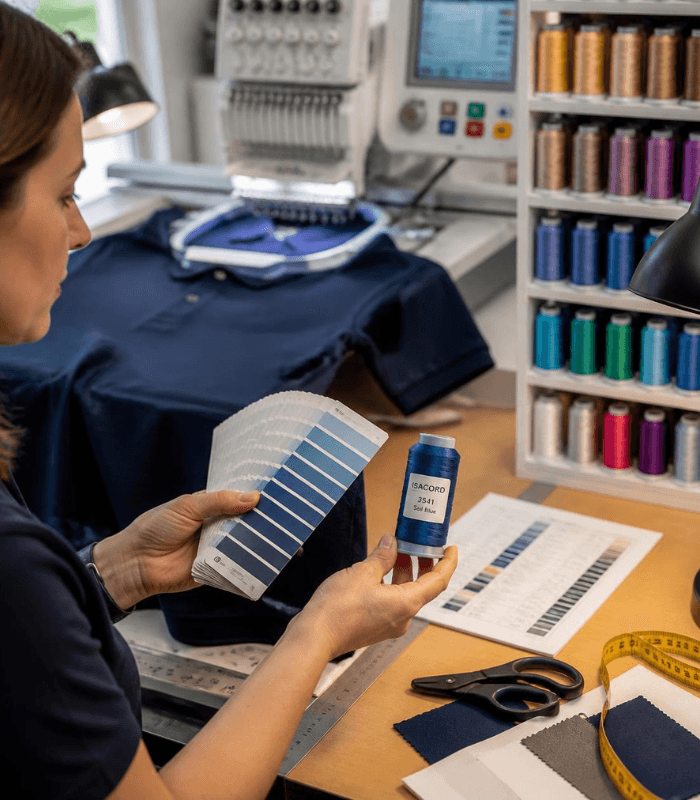
I once spent forty minutes standing in my studio holding a client’s logo sheet next to a spool of Isacord 40, squinting at both under two different lamps, trying to convince myself that “Sail Blue” was close enough to Pantone 285C. It wasn’t. I found that out after the shirt was already hooped.
That’s the thing nobody tells you when you start doing embroidery for other people: color matching isn’t really about having a good eye. It’s about having a reliable chart and knowing how to read it — because your eye will lie to you under fluorescent lighting every single time.
So this is the chart I wish I’d had that day. It converts Isacord polyester thread numbers to their nearest Pantone equivalents, and to Exquisite thread numbers for anyone switching brands or matching what’s already loaded on a second machine. I’ll also walk you through how to use a conversion chart properly, because pulling the “closest” number off a page isn’t always the same as getting a match that looks right once it’s stitched.
Table of Contents
Why Isacord and Pantone Don’t Actually “Match”
Here’s the part that trips people up: Pantone is a print and design system — solid ink on paper. Isacord is a trilobal polyester thread — a fiber with a triangular cross-section that catches and reflects light. Those are two completely different materials, and light behaves differently on each of them.
What that means practically: a Pantone chip and its “closest” Isacord match will often look slightly different depending on the light in the room, the angle you’re viewing from, and even the fabric color underneath the stitching. A conversion chart gets you to the nearest available thread color — not a scientifically identical one, because that’s not something thread and ink can actually guarantee each other.
Sara’s Pro Tip: When a client sends a Pantone number, I always stitch out a small swatch on scrap fabric that matches their actual garment color before I commit to a full run. Screen colors, printed proofs, and stitched thread are three different conversations, and skipping the swatch step is how “close enough” turns into a redo.
The Isacord–Pantone Conversion Chart
Below are some of the most frequently requested conversions. I keep an expanded version of this pinned above my machine.
| Pantone | Closest Isacord Number | Isacord Name |
|---|---|---|
| 285C | 3541 | Sail Blue |
| 289C | 3336 | Navy |
| 390C | (see full breakdown below) | — |
| 391C | (see full breakdown below) | — |
| 485C | 1900 | Red |
| Black C | 0100 | Black |
| White | 0100 (reverse) / 0110 | White / Bright White |
For the full list of Pantone-to-Isacord numbers, Amann (the manufacturer behind Isacord) publishes an official conversion tool, and I’d always recommend cross-checking against it directly rather than relying on any single blog’s chart, including mine — thread manufacturers update their formulations occasionally, and numbers do shift.
If you’re specifically hunting down a match for Pantone 390C, I’ve got a dedicated breakdown with the exact closest Isacord number and a couple of backup options if you don’t have that spool on hand. Same goes for Pantone 391C — it’s a shade that gets confused with 390C constantly, so I wrote up the difference between the two and which Isacord number lands closest to each.
Converting Isacord to Exquisite Thread
If you’re moving between machines, shops, or just restocking with whatever’s in stock, you’ll eventually need to convert an Isacord number to its nearest Exquisite equivalent (or the other way around). Both are polyester embroidery threads, which actually makes this conversion a little more forgiving than the Pantone one — you’re comparing thread to thread, not thread to ink.
A few things I’ve learned doing this conversion for my own restocking:
- Match by undertone, not just by name. A “Royal Blue” from one brand can lean noticeably more purple or more teal than the other brand’s “Royal Blue.” Always compare the actual spools side by side if you can.
- Sheen matters as much as hue. Isacord has a particular high-sheen finish; some Exquisite lines sit slightly matte by comparison. On a large fill area, that sheen difference will show up more than the color difference will.
- Keep a physical swatch card. I made mine years ago by stitching a few passes of each thread color onto white cotton scraps and labeling them by brand and number. It’s saved me more times than any digital chart has, because it shows you the real stitched color, not a screen approximation of it.
How to Actually Use a Thread Conversion Chart (Without Getting Burned)
- Start with the fabric, not the thread. The same thread color reads differently on white versus navy versus heather grey. Always test on the actual garment color, or the closest scrap you have to it.
- Check under two light sources. Daylight and your workroom’s overhead lighting will not agree with each other. If a color passes both, it’s a safe match.
- Confirm before a bulk run. One test swatch takes five minutes. Ripping out a hundred shirts does not.
- When in doubt, size up your options. Most conversion charts will give you a primary match and sometimes a secondary “close” option — keep both nearby names in mind rather than committing to the first number you see.
A Quick Word on PET Yarn (Since People Ask)
I get this question a lot, usually from newer stitchers wondering why Isacord holds its color and shine so well wash after wash: it’s because Isacord is made from PET yarn — polyester fiber with a trilobal (triangle-shaped) cross-section rather than a round one. That shape is what gives polyester embroidery thread its brightness, since the flat facets catch light the way a cut gemstone does. I go into this in more detail, including how PET thread compares to rayon and cotton embroidery thread, if you want the full explanation.
The Takeaway
A conversion chart gets you close. A physical swatch, tested under real light on real fabric, is what gets you right. Keep both tools in your back pocket, and you’ll stop second-guessing yourself under those studio lamps the way I did with that Pantone 285C order all those years ago.