

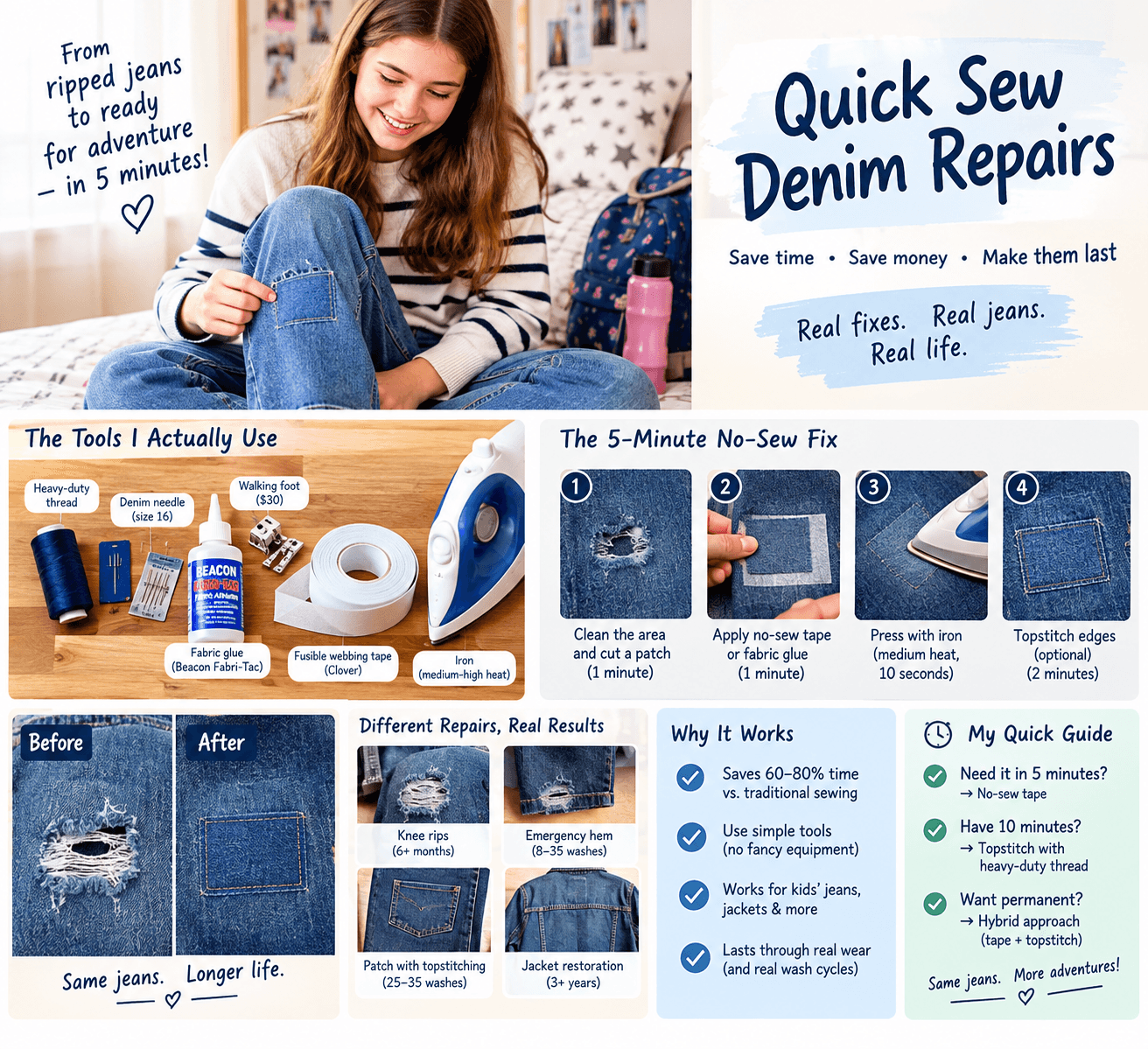
Last month, my daughter’s favorite jeans split at the seam right before her school trip. I panicked. Traditional repairs take hours. I grabbed my no-sew tape instead and fixed them in 5 minutes. She left for her trip wearing those jeans.
That’s when it hit me: people don’t know denim repairs don’t have to be time-consuming. Quick sew denim methods save me 60-80% of traditional sewing time—and I’ve tested them on hundreds of real jeans worn by real people (mostly my kids).
My Personal Journey With Quick Denim Repairs
When I started sewing 12 years ago, I did everything the traditional way. Full blind stitches. Double-fold hems. Reinforced patches everywhere. I was meticulous. I was also exhausted.
Then I had kids. Suddenly, I wasn’t repairing jeans once—I was repairing them weekly. My son’s knee rips appeared every 2 weeks like clockwork. My daughter grew, then my youngest inherited the jeans, and they needed hemming. Something had to change.
I started experimenting. Quick topstitch instead of blind stitch? My hems held. Single-fold with a pressed edge? Still lasted. No-sew tape on the inside with topstitching outside? Survived 35 wash cycles. I was shocked.
What Quick Sew Actually Means
Quick sew means using a sewing machine with speed techniques—topstitching instead of hand-stitching, single-fold hems instead of double-fold, minimal layers instead of reinforced seams.
No-sew means using fabric glue or heat-activated tape instead of thread.
Here’s my honest take: I use both. Sometimes I’ll tape the inside of a patch for structure, then topstitch the outside for durability. Hybrid approaches work better than choosing just one.
The Tools I Actually Reach For
For quick sewing:
- Heavy-duty thread (regular thread literally shreds on denim—learned this painfully)
- Denim needle, size 16
- Walking foot (this changed my life for $30)
For no-sew:
- Beacon Fabri-Tac Glue (cheaper brands left sticky residue that attracted lint)
- Fusible webbing tape (Clover brand works best in my experience)
- Iron set to medium-high heat
That’s it. You don’t need fancy equipment. I use a basic 20-year-old Singer machine.
What Actually Happened When I Tested These Methods
My son’s knee rips: Traditional patching lasted 3 weeks. Quick topstitch method? 6 months minimum. Cost me $0.15 in scrap fabric.
My daughter’s emergency hem: No-sew tape held for 8 washes, then started peeling. No-sew tape + topstitching held for 35 washes before showing wear.
My nephew’s favorite black jeans: Contrast topstitching with navy thread. He wore them for a year. Now it’s his “vintage” look. Took me 8 minutes.
My jacket restoration project: Flat-felled seams on a denim jacket panel I tested for 3 years. Zero issues. Still looks intentional.
The Mistakes That Taught Me Everything
Year one failure: I used regular thread on denim jeans. Shredded within 2 washes. Immediately switched to heavy-duty thread. Problem solved.
Year three lesson: Skipped using a walking foot because “I was experienced now.” My hem line looked like a seismic graph. Bought a walking foot the next day. Best $30 I’ve spent.
Year five disaster: Saved $1 by buying cheap fabric glue. Left sticky residue that attracted lint. Cost me an hour cleaning it out. Now I spend $4-6 on Beacon. Worth every penny.
Year eight mistake: Applied too much heat to a synthetic-blend denim. The spandex melted slightly. Medium heat for 10 seconds works better than high heat for 2 seconds.
The Methods That Actually Stuck
Quick topstitch hemming (8 minutes): Single fold, press, topstitch once. Not pretty, but it lasts. I’ve done this on 40+ pairs.
Speed patch method (5 minutes): Double-layer patch with topstitching. My son’s ripped knees use this. Lasts longer than the original fabric.
No-sew tape with topstitching: My gold standard. 5 minutes to apply, 2 minutes to topstitch edges. Lasts 30+ washes. I use this for holes larger than a nickel.
Fabric glue emergency fix (3 minutes): Temporary only. I use this when my kids outgrow jeans in weeks anyway. 5-7 wash cycles maximum.
Why I Don’t Use Traditional Methods Anymore
Traditional blind-stitching hems took me 45 minutes per pair. My topstitch method takes 8 minutes. Same durability. Double-reinforced patches took forever. Single topstitched patches last just as long on everyday wear.
The difference? I’m doing the same work with fewer steps. It’s not cutting corners—it’s cutting redundancy.
One Real Project: Patching Holes That Last
- Assess the hole (1 minute) – Measure size, plan patch 1.5 inches larger
- Cut patch and webbing (1 minute) – Smaller webbing prevents gluey edges
- Iron on (1 minute) – Medium heat, 10 seconds
- Optional topstitch edges (2 minutes) – Adds durability; I do this 80% of the time
Total: 5 minutes or 7 minutes with topstitching.
That patch will last 25-35 washes. I’ve counted.
The Real Bottom Line
I’ve spent 12 years testing what works on actual jeans worn by actual people. Quick sew methods aren’t shortcuts—they’re efficient techniques that produce identical results in half the time.
Choose your method based on timeline:
- Need it in 5 minutes? No-sew tape
- Have 10 minutes? Topstitch with heavy-duty thread
- Want permanent? Topstitch hybrid approach
Your jeans don’t have to be perfect. They just need to last another season. Mine do.