
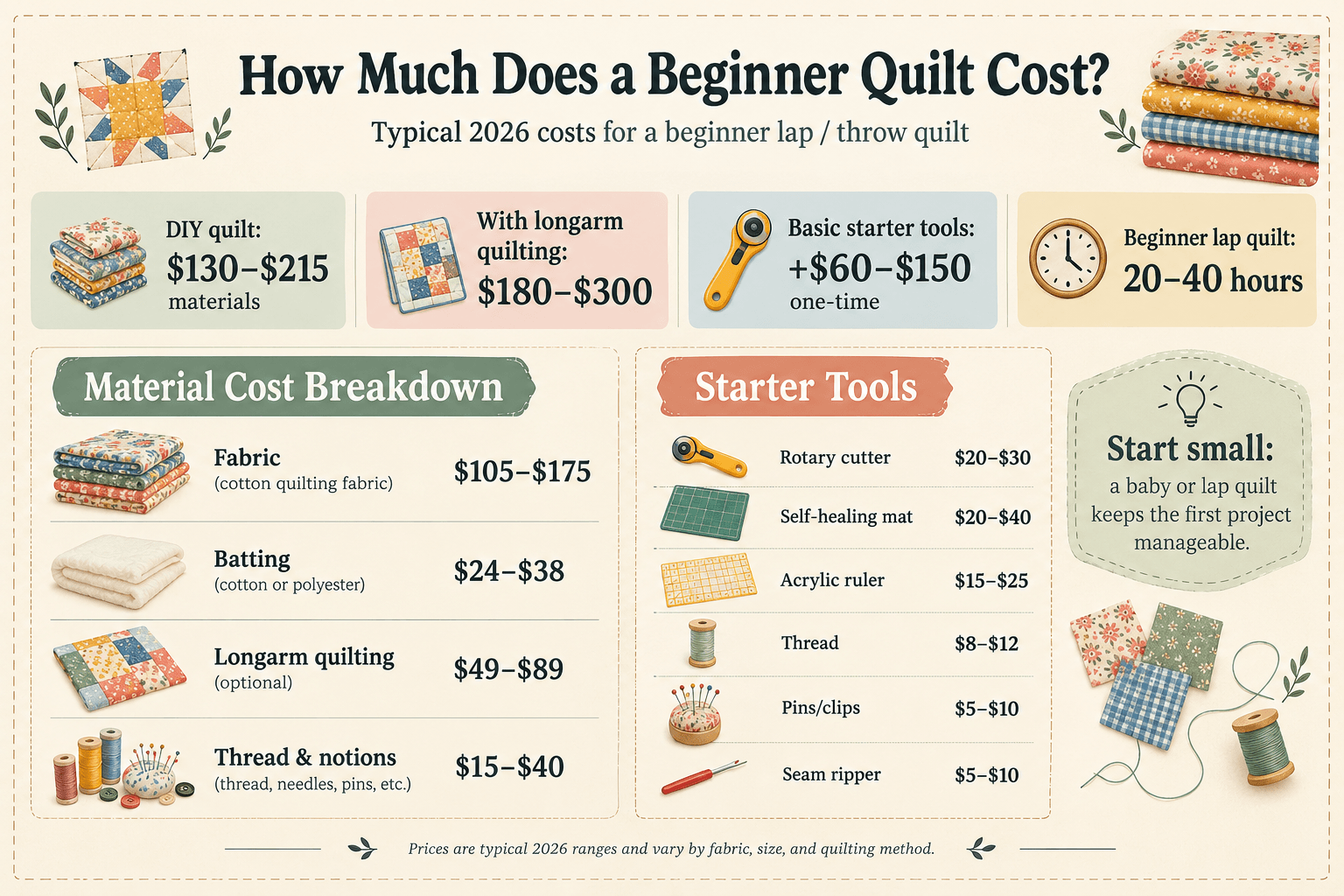
A beginner lap quilt costs about $130 to $215 in fabric and batting if you quilt it yourself, or about $180 to $300 if you pay a longarm quilter. Starting from zero, add $60 to $150 for basic tools. Hand quilting costs about the same in materials, but takes far more hours. A queen-size quilt costs roughly double a lap quilt.
Table of Contents
How Much Does It Cost to Make a Quilt?
It costs about $130 to $300 to make a lap quilt, depending on whether you quilt it yourself or hire someone. Your first quilt also needs tools, which adds $60 to $150 one time.
That’s the short version. The long version is the one I wish someone had told me before my first fabric shop trip. I walked in thinking, “It’s just cotton squares.” I walked out with a receipt that made me sit in the car for a minute.
So let’s go through it properly, line by line, with real 2026 numbers.
What Does It Really Cost to Start Quilting?
Starting costs are the tools you buy once and keep using for years. Most guides put a careful beginner kit between $60 and $150. If you buy everything new and don’t shop around, it can reach about $200.
I’ll be honest. My first shopping list had 30 items on it. I needed about eight.
Starter Tools and Supplies You Need
Here’s what I’d buy again, with typical 2026 prices:
| Item | Typical price | Why you need it |
|---|---|---|
| Rotary cutter (45mm) | $20–$30 | Cuts straight, fast and accurate |
| Self-healing mat (18″x24″) | $20–$40 | Protects your table and your blade |
| Acrylic ruler (6″x24″) | $15–$25 | Guides every cut |
| Cotton thread | $8–$12 per spool | Piecing and quilting |
| Pins or clips | $5–$10 | Holds seams in place |
| Seam ripper | $5–$10 | You will use it. A lot. |
| Iron and board | Often already owned | Flat seams, tidy blocks |
The three things I’d never cheap out on are the rotary cutter, the mat and the ruler. A cheap ruler slips. A slipped ruler ruins fabric. Ruined fabric costs more than a good ruler.
You don’t need a special quilting sewing machine for your first projects. A basic machine that sews a steady straight stitch is enough.
Optional Extras You Can Skip at First
- A second and third ruler (buy them when a pattern asks for one)
- Fancy scissors (the rotary cutter does most of the cutting)
- Precut fabric bundles (they cost more per yard than regular fabric)
- A quilting-only machine or a longarm of your own
Average Price of a Quilt
The average price depends mostly on size. Bigger quilt, more fabric, more batting, more quilting.
Here’s my rough math for a beginner-friendly quilt using standard quilting cotton:
- Fabric: A lap quilt needs about 9 to 11 yards in total, top, backing and binding together. Quilting cotton in 2026 averages around $11.71 a yard, and many online shops list it between $11 and $16. That’s about $105 to $175.
- Batting: Two yards at roughly $12 to $19 a yard is about $24 to $38.
- Quilting: Doing it yourself on a home machine costs nothing extra. A longarm quilter charges about $49 to $89 for a lap quilt.
Average Cost by Quilt Size (Baby, Lap, Twin, Queen)
The longarm column uses typical rates of about $0.015 to $0.0275 per square inch.
| Quilt size | Approx. size | Longarm quilting only |
|---|---|---|
| Baby | 40″x50″ | $30–$55 |
| Lap / throw | 50″x65″ | $49–$89 |
| Twin | 70″x90″ | $94–$173 |
| Queen | 90″x108″ | $146–$267 |
Most longarm shops also have a minimum charge, often $25 to $75, so a tiny quilt can cost more than the math says.
Homemade vs. Store-Bought Quilt Prices
Here’s the part that surprised me. A mass-made quilt from a big store is almost always cheaper than making one. If you’re quilting only to save money, you’ll be disappointed.
But a store quilt won’t have your fabric choices, your stitching, or the story behind it. That’s what you’re paying for.
Material Cost Breakdown
Fabric Cost
Fabric is the biggest bill. Quilting cotton sold at quilt shops usually runs $11 to $16 a yard. A fat quarter (a quarter-yard cut) is around $4 each, which works out to about $16 a yard. So fat quarters cost more per yard than a regular yard. I learned that after buying a pretty bundle I didn’t need.
Cheaper basic cotton exists, but check the weight and weave. Thin fabric frays, puckers and wears out fast.
Batting Cost
Batting is the soft layer in the middle. In 2026, popular types sell at roughly:
- Cotton with scrim: about $12 to $17 a yard
- Cotton-poly blend: about $14.50 to $16 a yard
- Wool: about $19 a yard
Cotton feels cozy and gives that classic crinkly look after washing. Poly is lighter and cheaper in some stores. Wool is warm and light but costs more.
Backing and Binding Cost
Backing should be a few inches bigger than your quilt top on every side. For a queen quilt, that’s a lot of fabric. Wide-back fabrics cost more per yard, but they save you from piecing a seam. If you pay a longarm quilter to piece your backing, expect about $10 a seam.
If you want binding done for you, some shops charge around $0.20 per inch. A lap quilt edge is about 230 inches, so that’s roughly $46.
Thread, Needles and Notions
Budget $15 to $40 for thread on a first quilt. Use good cotton thread. Cheap thread leaves lint in your machine and snaps at the worst moment.
How Much Does It Cost to Sew a Quilt?
Sewing Machine Costs
Machine prices swing too much to give you one honest number. Used machines, beginner machines and brand-new ones all work. The best machine to start with is the one you can already get your hands on. Borrow one, buy used, or rent time at a local shop.
Quilting Machine and Longarm Fees
If you’d rather not quilt the layers yourself, a longarm quilter will do it. Most charge by the square inch:
- Edge-to-edge (all-over patterns): about $0.015 to $0.03 per square inch
- Custom quilting: about $0.04 to $0.06 and up
- Thread: sometimes an extra charge
Here’s the quick formula. Multiply the quilt’s width by its length, then multiply by the rate. A 60″x60″ quilt is 3,600 square inches. At $0.0275, that’s $99.
For my first quilt, I paid for longarm quilting. The finished result looked ten times more professional than I could have done, and I still had the fun of piecing the top.
How Much Does It Cost to Make a Quilt by Hand?
Hand quilting costs about the same as machine quilting in fabric and batting. The difference is time, not money.
You’ll spend a little on a hand-quilting needle set, a thimble and a hoop, usually under $50 in total. Some quilters add a nicer hand-quilting thread.
What you don’t pay in dollars, you pay in hours. A hand-quilted lap quilt can take weeks of evenings. If you hire someone to hand-quilt for you, expect the price to be many times higher than machine quilting.
How Much Does It Cost to Make a Quilt Out of Shirts?
A shirt quilt can be one of the cheapest quilts to make, because the fabric is free if you already own the shirts. Expect about $30 to $80 for batting, backing, thread and stabilizer.
If you’re buying shirts from a thrift store, add a few dollars per shirt. Cotton button-ups work best. Stretchy knits need interfacing so they don’t warp, which adds a little cost.
These project ranges are my own estimates from the material prices above, not fixed prices.
How Much Does It Cost to Make a Rag Quilt?
Rag quilts use exposed seams that fray and fluff after washing. They’re forgiving, so they’re great for beginners.
A lap-size rag quilt usually costs $60 to $150 in materials. Flannel and cotton are common choices, and the batting is often cut into squares. You’ll need a sharp pair of snips, and the washing step takes a lot of lint-catching.
How Much Does It Cost to Make a Baby Quilt?
A baby quilt is the best first project for your budget. It needs roughly 4 to 5 yards of fabric in total, plus batting.
Expect about $50 to $100 for materials. Add $30 to $55 if you pay for longarm quilting. Choose soft, pre-washed cotton, since babies chew everything.
How Much Does It Cost to Make a Puff Quilt?
Puff quilts are stuffed with batting or fiberfill, so they eat more fabric and filling than a flat quilt. A lap-size puff quilt typically lands around $80 to $200.
They’re time-hungry, too. Every puff is sewn and stuffed individually.
How Much Does It Cost to Make a Memory Quilt?
If you’re using old clothes, the fabric is free, but the supplies still add up. Plan on $40 to $120 for stabilizer or interfacing, backing, batting and thread.
Memory quilts are worth planning carefully. Take your time cutting, because you can’t replace a sentimental shirt.
Time Involved for the Maker
Time is the cost nobody puts on a receipt.
How Many Hours a Quilt Takes
A beginner lap quilt usually takes 20 to 40 hours from the first cut to the last stitch of binding, if it’s machine quilted. Hand quilting can add many more hours.
Time by Quilt Type
- Baby quilt: a few weekends
- Rag quilt: fast, but lots of snipping
- Puff quilt: slow and fiddly
- Shirt or memory quilt: extra prep time for cutting and stabilizing
Why Do Homemade Quilts Cost So Much?
Labor and Skill
When a quilter sells a quilt for $400, it isn’t a rip-off. If a quilt takes 30 hours, a $400 price means about $13 an hour before materials. Most handmade quilts are underpriced.
Quality Materials
Good cotton, soft batting and strong thread cost real money. They also make the quilt last for decades instead of a couple of winters.
Why Handmade Quilts Are Priced Higher Than Store Quilts
Factories buy fabric by the truckload and stitch quilts in seconds. A single maker can’t compete on price. They compete on quality, design and meaning.
Is Quilting an Expensive Hobby?
It can be, but it doesn’t have to be. Compared with many hobbies, quilting has a low entry fee. You can start for around $60 to $150 in tools, and the tools last.
The cost creeps up when the fabric stash grows. I’ll admit, mine did.
Cost to Start vs. Ongoing Cost
- To start: tools, about $60 to $150
- Per quilt: about $130 to $300 for a lap quilt
- Over time: new rulers, blades, thread and, yes, more fabric
How to Quilt on a Budget
- Use coupons at big fabric stores
- Buy yardage instead of precuts
- Use bed sheets or thrifted cotton for backing (wash and check them first)
- Quilt a small project first
- Reuse old shirts or scraps
- Provide your own batting and backing to a longarm quilter
Common Beginner Mistakes That Waste Money
- Buying too many tools at once. Start with the basics.
- Choosing very cheap fabric. It frays and fades.
- Skipping pre-measuring. Running short on fabric means a second trip.
- Buying precuts for every project. They cost more per yard.
- Forgetting extra backing. Backing must be larger than the top.
- Starting with a king-size quilt. Start small.
FAQ
How much does a beginner quilt cost?
A beginner lap quilt costs roughly $130 to $215 in materials if you quilt it yourself. Tools add $60 to $150 the first time.
Is it cheaper to buy or make a quilt?
Buying a mass-made quilt is usually cheaper. Making one costs more but gives you control over the fabric, size and quality.
Is hand quilting cheaper than machine quilting?
The materials cost about the same. Hand quilting takes much more time, and it costs far more if you pay someone to do it.
What is the cheapest type of quilt to make?
A shirt quilt, memory quilt or small baby quilt made from scraps is usually the cheapest.
How long does it take to make a quilt?
A beginner lap quilt usually takes 20 to 40 hours. Larger and hand-quilted projects take longer.
Conclusion: Is Quilting Worth the Cost?
For me, yes. Not because it’s cheap, because it isn’t. But a quilt is something you can wrap around someone you love, and no store sells that.
Start small. Buy the three core tools well. Pick a baby or lap quilt for your first project. And write down what you spend. It’s the best way to keep the hobby fun instead of scary.
About the Author: Sara McLean is the creator of AppliquéFits.com and a textile designer who shares practical appliqué, sewing, and fabric-design ideas.