

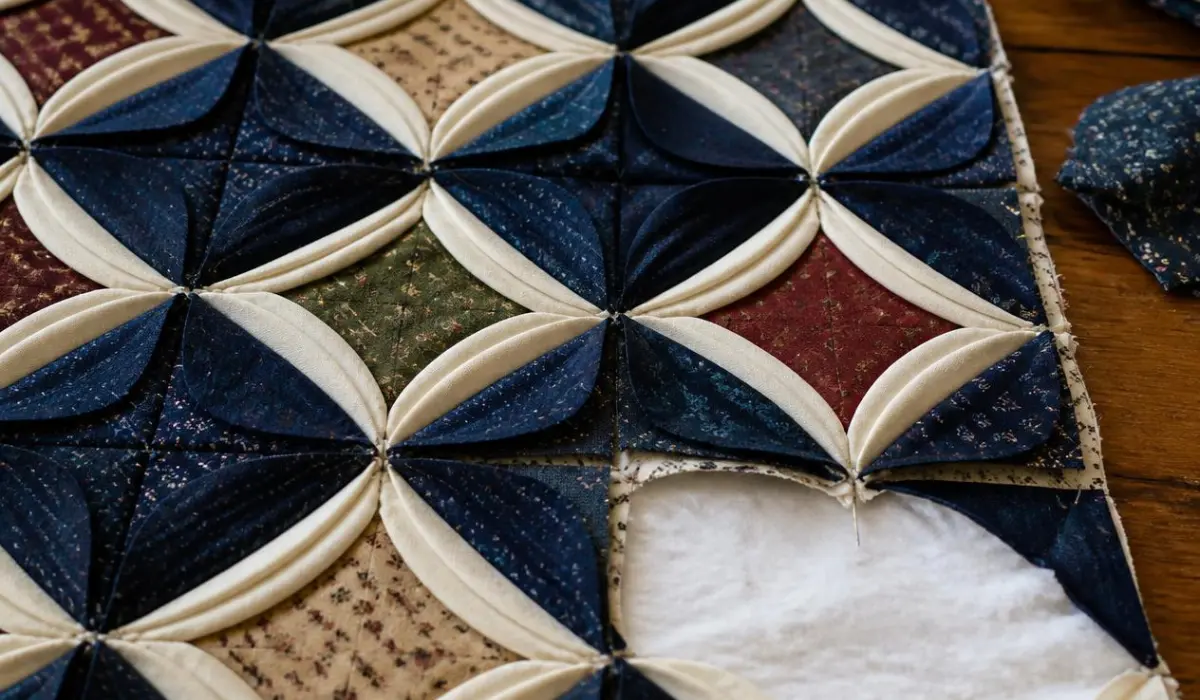
Traditionally, a cathedral window quilt is made without batting — the folded-fabric construction creates its own thickness and a finished quilt back with no need for a middle layer. However, many modern quilters do add batting between the block and the backing to make a warmer, softer cathedral window quilt, especially when using it as a bed quilt rather than a decorative wall hanging.
Table of Contents
Why Traditional Cathedral Window Quilts Skip Batting
The cathedral window pattern is a folding technique, not a piecing technique. Muslin squares are folded into envelopes, pressed, and then curved fabric “windows” are stitched on top, creating dimension and structure from the fabric itself. This quilt-as-you-go method already produces a finished front and back at the same time, so there’s no separate quilt sandwich to assemble the way there is with a standard pieced quilt.
In my own workshops, this surprises a lot of new quilters. They assume every quilt needs batting by default, but cathedral window blocks get their loft from folded fabric layers, not from an inserted layer of batting. That’s part of what makes the technique unique among patchwork and appliqué styles.
When Batting Makes Sense for This Pattern
Batting isn’t wrong for cathedral window quilts — it’s simply optional, and the right choice depends on your project’s purpose:
- Bed quilts or throw quilts – adding batting boosts warmth, which traditional muslin-only construction doesn’t provide on its own.
- Wall hangings or table runners – skip the batting; the folded fabric already gives enough body, and lighter weight makes the piece easier to display.
- Modern machine-piecing methods – many updated cathedral window tutorials sandwich a block with batting and backing before quilting the curved windows, blending the traditional look with a standard quilt sandwich.
How to Add Batting to a Cathedral Window Quilt
If you want a warmer finished piece, here’s the general process modern patterns use:
- Piece your cathedral window blocks using the folding and curving technique, either by hand or machine.
- Layer with batting and backing. Cut both slightly larger than your pieced top, the same way you would for any quilt sandwich.
- Stitch the window curves through all three layers, which secures the batting in place at the same time as the decorative topstitching.
- Trim and finish the edges. Because the folded frame fabric already wraps the raw edges in many methods, some cathedral window quilts don’t need separate binding.
Choose a low-loft batting, like cotton or a cotton-poly blend, since the pattern already has visual texture from the curved windows — a high-loft batting can add unnecessary bulk and make the curves harder to stitch cleanly.
Tips for Beginners
- Press every fold firmly before stitching; crisp folds are what make the curved “windows” lie flat.
- Use high-contrast fabric between the frame and window pieces so the pattern reads clearly.
- If adding batting, choose a thin, low-loft option to avoid bulk while stitching curves.
- Practice one block before a full quilt top — the folding technique has a learning curve.
Common Mistakes
- Assuming batting is required, when it’s actually optional for this pattern.
- Using high-loft batting, which makes curved stitching bulky and uneven.
- Skipping pressing between folds, which leads to messy, uneven windows.
FAQ
1. Do cathedral window quilts need batting?
No. Traditional cathedral window quilts are made without batting, since the folded fabric construction already provides thickness and a finished back.
2. Can I still add batting for warmth?
Yes. Many modern quilters layer batting and backing under the pieced top for a warmer bed quilt or throw quilt.
3. What loft of batting works best for this pattern?
Low-loft cotton or cotton-poly batting works best, since it adds warmth without making curved topstitching difficult to sew.
4. Is cathedral window a beginner-friendly pattern?
It has a learning curve due to the folding technique, but it uses simple straight and curved stitching, making it approachable with practice.
5. Does a cathedral window quilt need binding?
Often not. Because the folded frame fabric wraps the raw edges in many methods, this quilt-as-you-go pattern can be finished without separate binding.
 Minty Mellon