

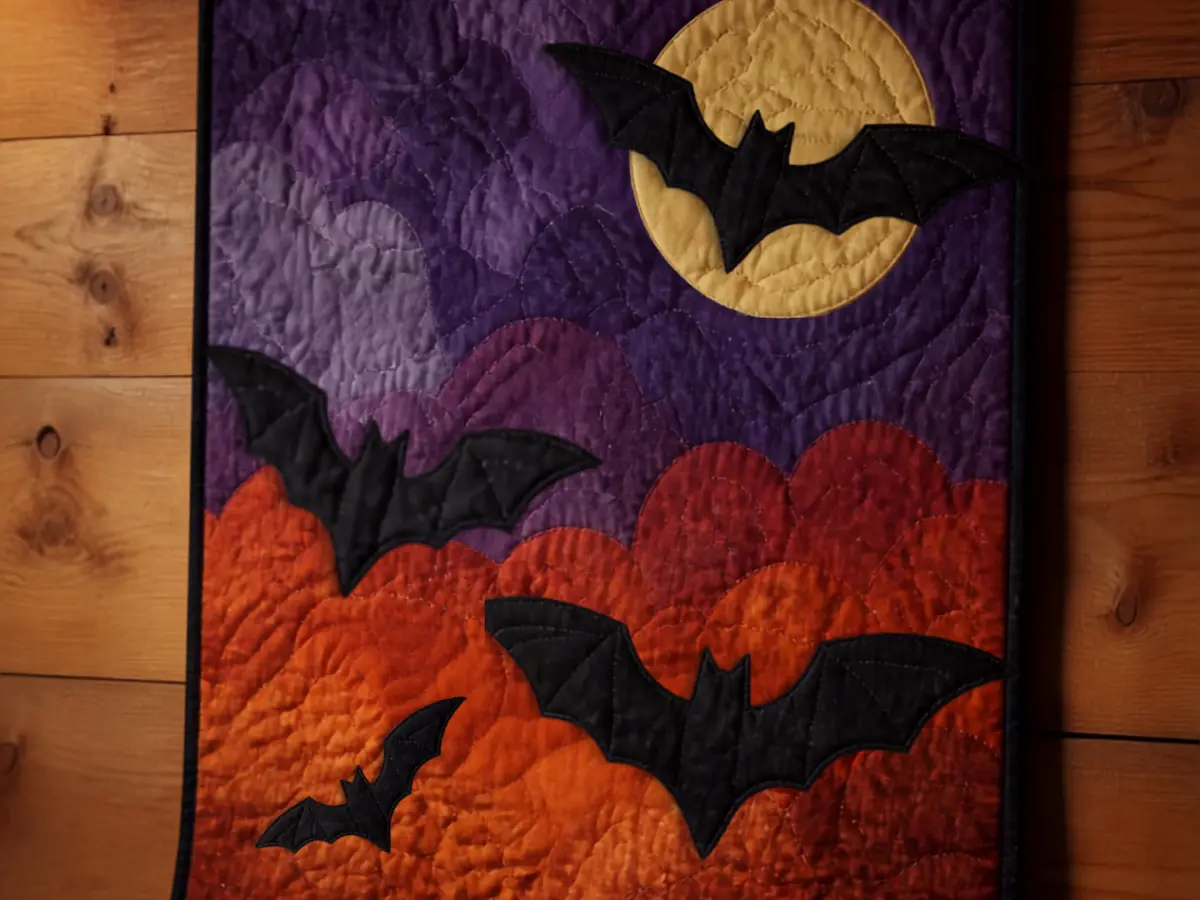
If you’ve browsed Halloween quilt patterns, you’ve probably run into “Dancing with Bats” — a small wall-hanging design that shows up every fall, usually featuring a cluster of black bat silhouettes mid-flight against a moody background. It’s become something of a seasonal classic among applique quilters. It’s spooky, but in a fun, not-trying-too-hard kind of way.
Let’s walk through what makes this style of pattern work, and how you can put together your own version, whether you’re following a purchased pattern or just riffing on the idea with your own bat shapes.
Table of Contents
What Makes This Pattern Style Tick
At its core, a dancing-bats design is a raw-edge or fusible applique wall hanging, usually somewhere in the 20-inch range, small enough to finish in a weekend. The bats are typically cut from solid black fabric and arranged in motion — wings mid-flap, bodies angled like they’re caught in a gust of wind — against a background that might include a moon, a pumpkin, or a rich autumn-toned print.
What I love about this kind of project is that it doesn’t demand advanced piecing skills. The technique is almost entirely about shape placement and confident fabric choices. A few bats, a good background, some simple quilting to hold it together — that’s really the whole formula.
Building Your Own Version
You don’t need to track down a specific commercial pattern to make something in this spirit. Here’s roughly how I’d approach it if I were starting from scratch.
What You’ll Need
- Background fabric (a rich purple, deep orange, or charcoal reads well for a night sky)
- Solid black fabric for the bat shapes
- Fusible web, if you’re doing machine applique
- Batting, cut a couple inches larger than your background
- Backing fabric
- Embroidery or contrast thread for details like eyes or wing veins
- A basic bat template — you can freehand one or trace a simple silhouette
Steps
- Sketch or trace your bat shapes, varying the wing angles so the flock feels like it’s actually moving, not just repeated stamps of the same shape.
- Cut your applique pieces. If using fusible web, iron it to the back of your black fabric before cutting, which keeps the edges clean.
- Arrange before you commit. Lay the bats on your background and live with the placement a bit. Diagonal, scattered groupings read as more “in flight” than a neat row.
- Fuse and stitch. Press the bats into place, then secure the edges with a straight stitch, zigzag, or blanket stitch.
- Layer with batting and backing, the same way you would for any small quilt sandwich.
- Quilt it. Simple straight lines or a light meander work well, since the applique is already doing the visual heavy lifting.
- Trim and bind, then add a hanging sleeve if you want to display it on a wall.
A Few Things Worth Knowing
Since this is a wall hanging rather than a bed quilt, a lower-loft batting works fine — it doesn’t need much warmth, just enough body to hold the quilting lines and give some dimension when hung.
If you’re using a purchased pattern rather than freehanding your own bats, remember that pattern templates and instructions are the designer’s copyrighted work. Buying the pattern supports the person who created it.
Common Mistakes I See
- Cutting all the bats the exact same size and shape, which flattens the sense of motion.
- Using a background fabric that’s too busy, so the bats disappear instead of standing out.
- Over-quilting the background, which pulls attention away from the applique.
Tips for a Better Result
- High contrast between the bats and the background is what sells the design, so don’t be shy about dark background, solid black bats.
- A tiny bit of contrast thread for wing detail adds a surprising amount of depth for very little effort.
- This is a great project to practice machine applique on, since the shapes are forgiving and mistakes hide well in solid black fabric.
FAQ
Do I need batting for a small wall hanging like this?
It’s optional, but a thin, low-loft batting gives the piece enough body to hang nicely without adding much bulk.
What’s the easiest applique method for bat shapes?
Fusible applique is the most beginner-friendly option, since it holds fabric in place before you stitch and skips hand-basting.
Can I use this design on a bigger quilt, not just a wall hanging?
Yes, the same bat-cluster idea scales up nicely for a lap quilt or throw quilt with more background fabric and batting.
What fabric works best for the bat shapes?
A solid, tightly-woven black cotton cuts cleanly and holds its shape well under fusible web and stitching.
Is this a good beginner applique project?
Yes. The shapes are simple, mistakes hide easily in solid black fabric, and the project usually finishes in a weekend.
Written By Sara McLean, Textile & Applique Specialist — 12+ years quilting experience