
This question comes up in my inbox more than you’d think, and honestly, I don’t blame anyone for being confused. “Running stitch” and “straight stitch” sound like they should be the exact same thing — they’re both straight, they’re both simple, they both look like little dashes when you’re done. So what gives?
Turns out the mix-up makes sense, because the two terms are related, they just come from different worlds.
Table of Contents
Straight Stitch Is the Category. Running Stitch Is One Version of It.
Here’s the cleanest way I can put it: a straight stitch is any stitch that goes in a straight line, single and separate, without looping or crossing itself. That’s a broad umbrella. Under that umbrella you’ll find things like the seed stitch, the stem stitch’s cousins, and yes, the running stitch.
The running stitch, on the other hand, is specifically a series of small, straight stitches worked one after another along a line, with even gaps in between, all in one continuous pass of the needle. So while every running stitch is technically made of straight stitches, not every straight stitch is a running stitch. It’s the difference between a single brick and a whole brick wall — related, but not interchangeable.
Where the Confusion Really Comes From
A lot of the mix-up happens because of sewing machines. If you’ve ever seen “straight stitch” listed as a setting on your machine, that’s a single continuous line of machine stitching — completely different animal from hand sewing running stitch, even though the visual result (a straight line) looks similar from a distance.
On a sewing machine, running stitch isn’t really a native setting. What people usually mean when they say “running stitch on sewing machine” is setting the stitch length to its longest option to mimic that dashed, basting-style look by hand. It gets the job done for quick basting, but it’s not technically the same stitch — more of a machine stand-in for it.
Visual Differences You Can Actually See
If you’re staring at two pieces of fabric side by side trying to figure out which is which, here’s what to look for:
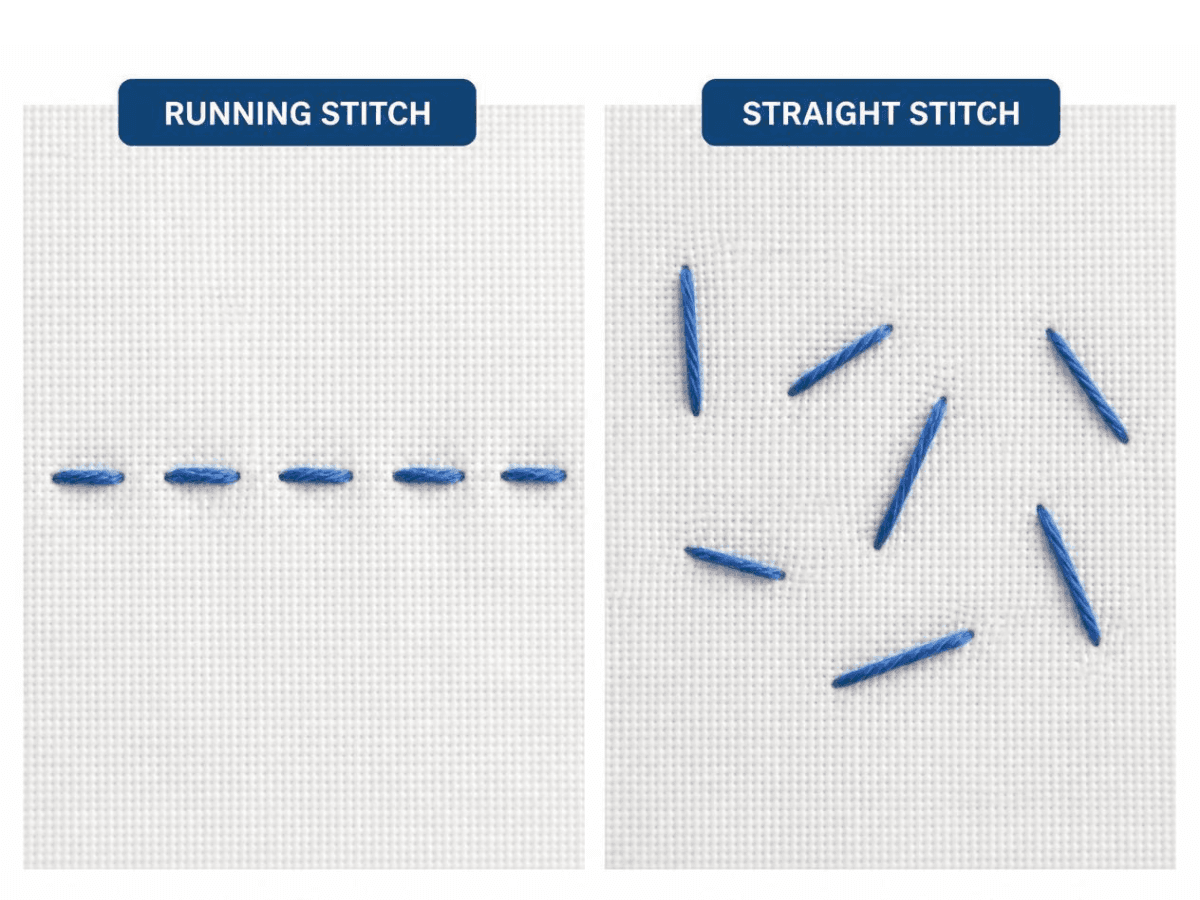
A straight stitch (in the general embroidery sense) is often used as an individual mark — think of little straight stitches scattered to look like grass, fringe, or texture, each one separate from the next, sometimes at different angles.
A running stitch reads as a continuous dashed line, evenly spaced, moving in one direction along a path — whether that path is straight, curved, or a full pattern like you’d see in sashiko.
So if what you’re looking at is a bunch of individual little marks going every which way, that’s more likely a straight stitch used decoratively. If it’s a tidy, rhythmic dash-dash-dash following a line, that’s your running stitch.
Does the Difference Actually Matter?
Honestly? For most everyday sewing, not hugely. If you’re basting a seam or hand quilting, you’re using running stitch and calling it “just sewing a straight line” and nobody’s going to correct you.
But if you’re getting into embroidery specifically — reading patterns, following a stitch dictionary, or trying to recreate something like sashiko — the distinction matters more. Patterns will often specify “running stitch” when they want that continuous dashed rhythm, and knowing the difference means you won’t end up with a bunch of scattered individual straight stitches instead of the clean line the pattern intended.
The Short Version
Straight stitch = the broad category of any non-looping straight stitch. Running stitch = a specific, repeated pattern of small, evenly spaced straight stitches worked continuously along a line.