

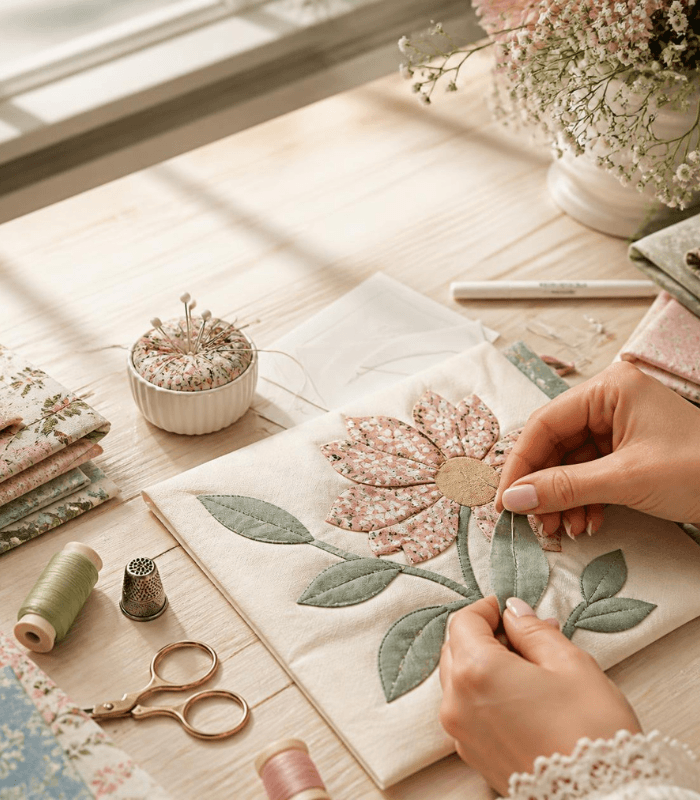
Slow stitching didn’t need a rebrand. It needed a recession, a pandemic, and a generation exhausted by anything that could be finished in an afternoon. Somewhere in that mix, needle turn appliqué — the most patient, least forgiving hand-sewing technique in the quilter’s repertoire — stopped being a grandmother’s hobby and became a genuine object of desire among makers who could, frankly, just buy a machine.
That’s the part worth sitting with. Needle turn appliqué is not efficient. It is not the fastest way to attach a fabric shape to a background, and it has never pretended otherwise. A shape is cut with a seam allowance, the raw edge is turned under with the tip of the needle in tiny increments, and the fold is tacked down with stitches so small they’re meant to disappear entirely into the fabric. No fusible web, no machine zigzag, no shortcuts. Every curve — and appliqué is built almost entirely out of curves, the more unreasonable the better — gets turned by hand, one eighth of an inch at a time.
The technique’s lineage runs straight through the Baltimore Album quilts of the 1840s, the ornate, floral, densely appliquéd showpieces that mid-Atlantic women stitched as both domestic art and social currency. Those quilts were never about warmth. They were about virtuosity, made to be looked at, signed, gifted, and remembered. Needle turn appliqué carries that same DNA today: it is the technique quilters reach for when the point is not to finish a blanket but to prove something can be done beautifully and slowly, by hand, in an era that has largely stopped asking anyone to.
What’s changed is who’s doing it and why. The applique needle turn revival tracks almost exactly with the broader slow-craft movement — visible mending, hand embroidery, the whole aesthetic universe currently living on certain corners of Instagram and Substack, where a single appliquéd block can take longer to finish than most people spend on an entire quilt top by machine. That imbalance used to read as impractical. Now it reads as the point. In a culture fluent in the language of burnout, a craft that cannot be rushed has its own kind of appeal — it forces a pace on the maker rather than the other way around.
There’s also a skill hierarchy at play, and quilters are not shy about it. Fusible appliqué, where a shape is ironed on and machine-stitched around the edge, is fast and durable and entirely respectable. But it doesn’t carry the same weight in a guild show or a family heirloom conversation. Turn needle appliqué — done properly, with invisible stitches and edges so smooth they look printed rather than pieced — is still the technique that separates a competent quilter from a serious one. It’s the hand-lettering of the fabric world: anyone can typeset a word, but not everyone can make it look inevitable.
The learning curve is real, and nobody selling a class pretends otherwise. Convex curves turn easily; concave curves and sharp points are where beginners lose whole evenings. The seam allowance has to be clipped just enough to release without fraying past the stitch line. Thread has to match the appliqué shape, not the background, so the stitches vanish into the piece they’re securing rather than the fabric behind it. None of this is intuitive on the first attempt, which is precisely why it functions as a credential. A well-turned point on a six-pointed star says more about a quilter’s hours logged than almost anything else in the medium.
What’s interesting is that the technique hasn’t modernized so much as it’s been rediscovered by people who never needed it to. Machine appliqué has existed, and improved, for decades — it’s faster, it’s washable without fear, and for a bed quilt that needs to survive a toddler, it’s the rational choice. Needle turn appliqué persists anyway, not because it’s better at the job but because the job was never really the point. The technique survives on the same logic that keeps darning mushrooms and embroidery hoops in circulation: it offers something a sewing machine, however sophisticated, cannot — the visible evidence of a person’s hand, unhurried, doing something difficult on purpose.
That’s the actual appeal of applique needle turn work in 2026: not nostalgia exactly, but a hunger for friction. For a process that resists automation not because no one has automated it, but because automating it would destroy the reason anyone wanted it in the first place.