
Every needle packet on a craft store shelf makes the same unspoken claim — that this one, specifically, is the one you need. Most of them are wrong for your project. A dull universal needle punching through denim skips stitches and shreds fibers; a heavyweight leather needle dragged through chiffon leaves holes the fabric never recovers from. The fix isn’t more needles. It’s knowing what each one is actually built to do.
Hand-Sewing Needles
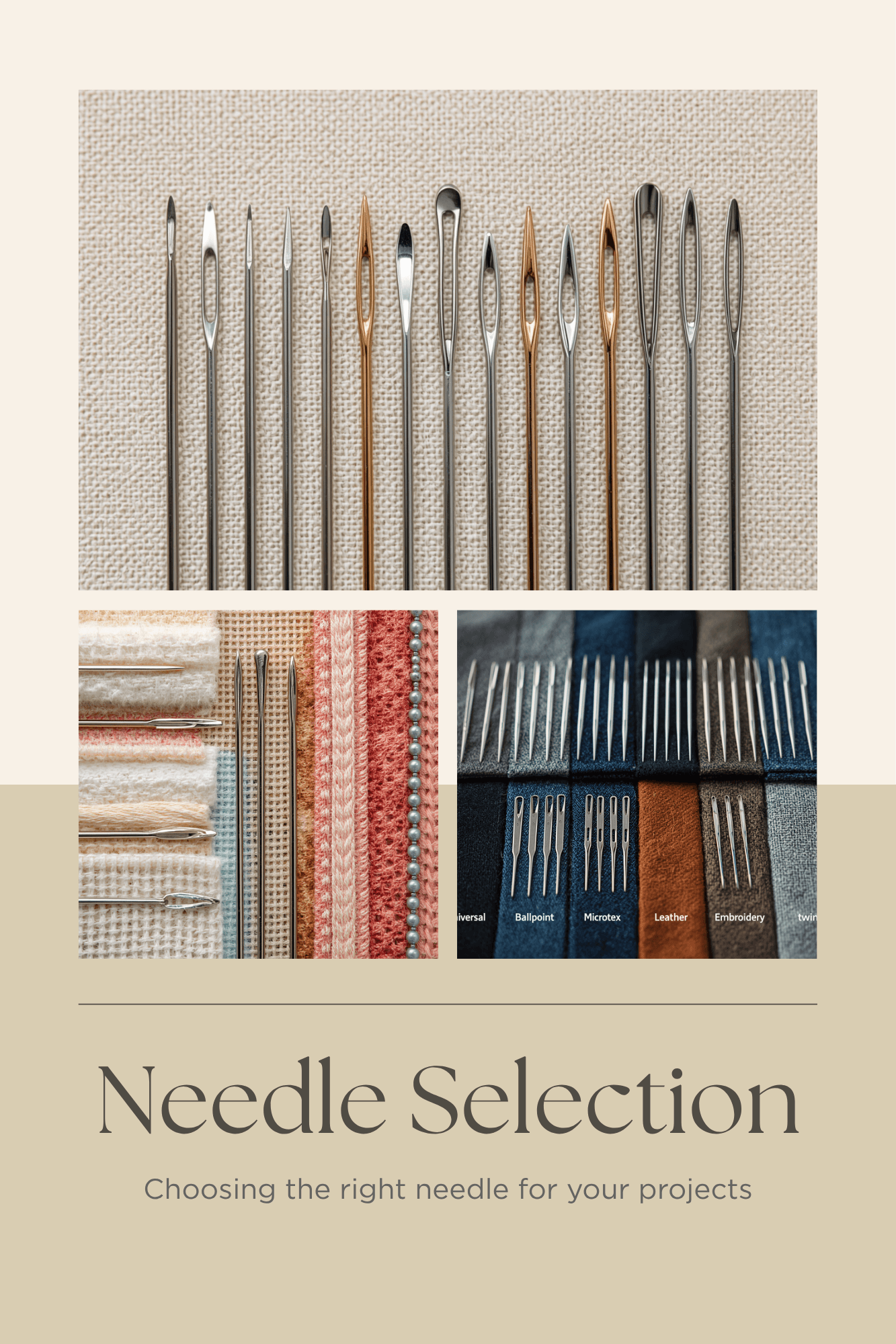
Sharps are the workhorse: medium length, small round eye, a point sharp enough to handle general sewing, hemming, and mending without a second thought. If a sewing kit only stocks one hand needle, this is it.
Betweens, often sold as quilting needles, are shorter and stiffer than sharps. Quilters reach for them specifically because the short shaft lets a rocking motion load several small, even stitches through multiple fabric layers at once — speed and precision in the same tool.
Embroidery needles, sometimes labeled crewel needles, keep that same sharp point but widen the eye to fit thicker embroidery floss or several strands bundled together.
Tapestry needles invert the formula entirely: blunt tip, oversized eye. Built for cross-stitch and needlepoint, where the goal is sliding between the woven threads of open-weave fabric, not through them.
Chenille needles look like tapestry needles but trade the blunt tip for a sharp one, which makes them the standard for ribbon embroidery and any decorative technique that has to pass through tightly woven cloth.
Milliner’s needles, also called straw needles, run unusually long — a length that pays off in basting, pleating, and wrapped stitches like French knots, where thread needs to wind evenly around the shaft.
Beading needles are thin enough to look fragile, built to clear a bead hole roughly the width of a pin.
Sewing Machine Needles
Machine needles are sized by number, and the logic runs backward from what most people assume: the higher the number, the thicker the needle. A 70/10 handles lightweight fabric like chiffon or voile; a 100/16 is built for denim or canvas. The core categories:
- Universal needles: a slightly rounded point that covers most woven and knit fabric — the default when nothing else is specified.
- Ballpoint needles: the rounded tip slips between knit fibers instead of piercing them, which is what stops runs in stretchy fabric like jersey or spandex.
- Sharp (Microtex) needles: an acute point for tightly woven fabric — quilting cotton, silk, microfiber — where the payoff is a crisp, precise line with no fuzzing at the seam.
- Denim/jeans needles: strong, sharp, reinforced shaft, built to punch through dense fabric instead of bending off it.
- Leather needles: a wedge-shaped point that cuts a path through leather and vinyl rather than trying to find fibers to slip between.
- Quilting needles: rounded and tapered, engineered to glide through several layers of fabric and batting without dragging.
- Embroidery machine needles: a larger eye and a gentle ballpoint that keep delicate rayon or polyester thread from shredding at high stitching speed.
- Twin/double needles: two needles on one shaft, used for parallel decorative rows or a clean, professional hem on knitwear.
How to Choose the Right Needle
Fabric weight and thread thickness decide the needle together — never separately. As a working reference:
- Lightweight fabric (chiffon, voile) → fine needle, size 60/8–70/10
- Medium-weight fabric (cotton, linen) → universal, size 80/12
- Heavyweight fabric (denim, canvas) → size 90/14–100/16
- Knits and stretch fabric → ballpoint or stretch needle
- Leather or vinyl → dedicated leather needle
Signs You Need to Change Your Needle
A dull or bent needle is behind more sewing problems than most people trace it back to. The tells:
- Skipped stitches
- A popping or snapping sound as the needle enters the fabric
- Visible pulls, snags, or runs in the material
- Thread that keeps breaking with no obvious cause
Swap the needle every 8–10 hours of active sewing — sooner, immediately, if it’s just gone through a pin, heavy fabric, or leather.
Final Thoughts
Needles cost almost nothing, and the right one changes everything about stitch quality and how the fabric holds up over time. Stock a handful of hand needle types and a spread of machine needle sizes, and there’s very little in garment construction, embroidery, or quick mending that can catch you unprepared.