
I sat in my first quilting circle completely silent. Everyone was throwing around terms like “FMQ” and “fat quarters” and “reverse appliqué” like it was English. I understood maybe three words in the entire conversation.
I wanted to scream “CAN SOMEONE JUST SAY THE FULL WORD?”
But I didn’t. I sat there pretending I knew what was happening. Nodding along. Feeling stupid.
Here’s the truth nobody tells you: quilting has its own language. And if nobody teaches you the vocabulary, you’ll feel left out forever.
I’m about to change that.
Table of Contents
Basic Quilting Words You Actually Need
Let’s start with the stuff you’ll see in literally every pattern.
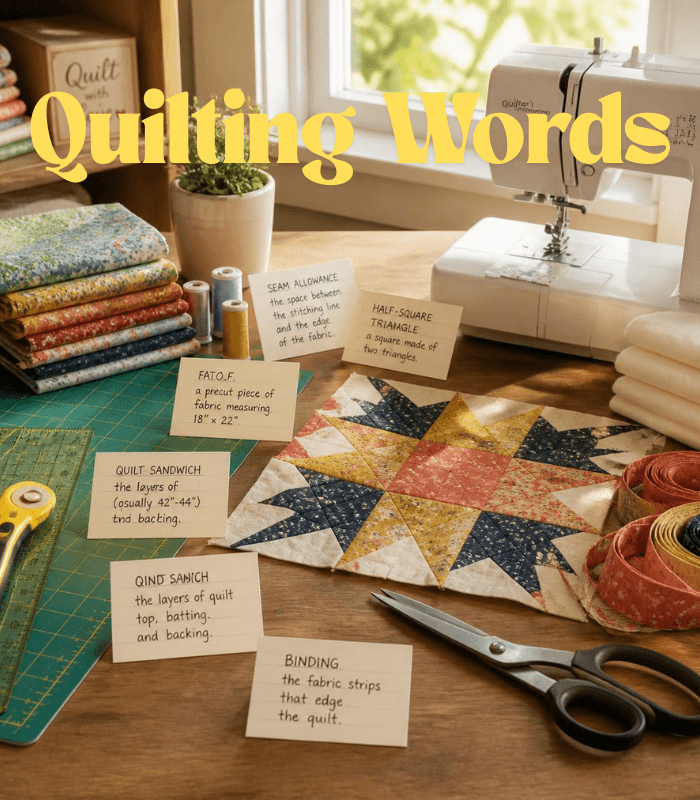
Fat Quarter A fat quarter is a piece of fabric cut from a larger bolt. It measures approximately 18 inches by 22 inches. Yeah, it’s a weird name. No, it doesn’t mean the fabric is chunky. It just means it’s wider than a traditional quarter-yard cut (which is super thin). Fat quarters are perfect for quilting projects.
WOF (Width of Fabric) This means the entire width of the fabric as it comes off the bolt—usually about 42-44 inches. When a pattern says “cut one piece WOF,” they mean use the whole width. Saves you guessing.
Batting The fluffy middle layer of your quilt. It’s what makes quilts warm and puffy. Think of it as the filling in a sandwich. You’ve got your quilt top (bread), batting (filling), and backing (bottom bread). Three layers. That’s a quilt.
Backing The fabric on the back of your quilt. Boring name. Important job. Without it, you’d just see all the messy thread on the underside.
Binding The fabric strip around the edge that finishes everything off. It folds over the raw edges and keeps everything neat. It’s the ribbon wrapping up your present.
Seam Allowance The space between where you stitch and where you cut. For quilting, standard seam allowance is ¼ inch. This is non-negotiable because it’s how all the pieces fit together. Mess this up and your blocks won’t match. (Trust me, I’ve learned this the hard way.)
Quilting Techniques You’ll Encounter
Piecing Sewing fabric pieces together to create a design. That’s it. You’re piecing.
Pressing Using an iron to flatten your seams after stitching. It seems simple but it changes everything. Pressed seams = crisp, professional-looking quilts.
Appliqué Cutting shapes from fabric and stitching them onto a base fabric. It’s more like collage than traditional piecing. This is where I spend half my time.
Improv (Improvisational Quilting) Making it up as you go. No pattern. No stress. Just fabric, instinct, and creativity. Sounds chaotic? It’s actually freedom.
FMQ (Free Motion Quilting) Using your sewing machine without a presser foot to stitch quilting lines freely. Looks like crazy scribbles at first glance. Looks incredible when you zoom out.
The Words That Intimidate Everyone
Scrap Quilting Using leftover fabric pieces instead of buying new. Smart and economical. Some people act like it’s a fancy technique. It’s not. It’s just using what you have.
English Paper Piecing (EPP) Hand-piecing fabric around paper templates. Takes forever. Incredibly calming. Produces stunning geometric quilts. Involves way more patience than I typically have.
Reverse Appliqué Cutting away the top layer to reveal fabric beneath. Sounds complicated. It’s not. You’re just removing stuff instead of adding it.
Quilting Line The stitching that goes through all three layers (top, batting, backing) to hold everything together. Without it, you just have three separate layers. The quilting line is what makes it an actual quilt.
Don’t Stress About Knowing Everything
When I started quilting, I thought I had to memorize a dictionary. Turns out? You learn terminology by doing.
You’ll pick up words naturally. Someone mentions “foundation piecing” and you’ll ask what that means. They’ll explain it. You’ll remember because you actually need it for a project.
Start with the basics:
- Fabric cuts (fat quarter, yardage)
- Parts of a quilt (top, batting, backing, binding)
- Basic techniques (piecing, pressing)
Everything else is bonus.
Quick Questions People Actually Ask
Q: Is it okay if I don’t know all these terms?
Yes. Nobody cares. Use the words you know. Ask when you don’t. Quilters are genuinely kind.
Q: Can I mix these techniques in one quilt?
Absolutely. Piecing + appliqué + FMQ = stunning. There’s no rule against combining methods.
Q: What if I mess up the seam allowance?
Your pieces won’t fit. Rip it and redo it. It happens constantly. You’ll survive.