

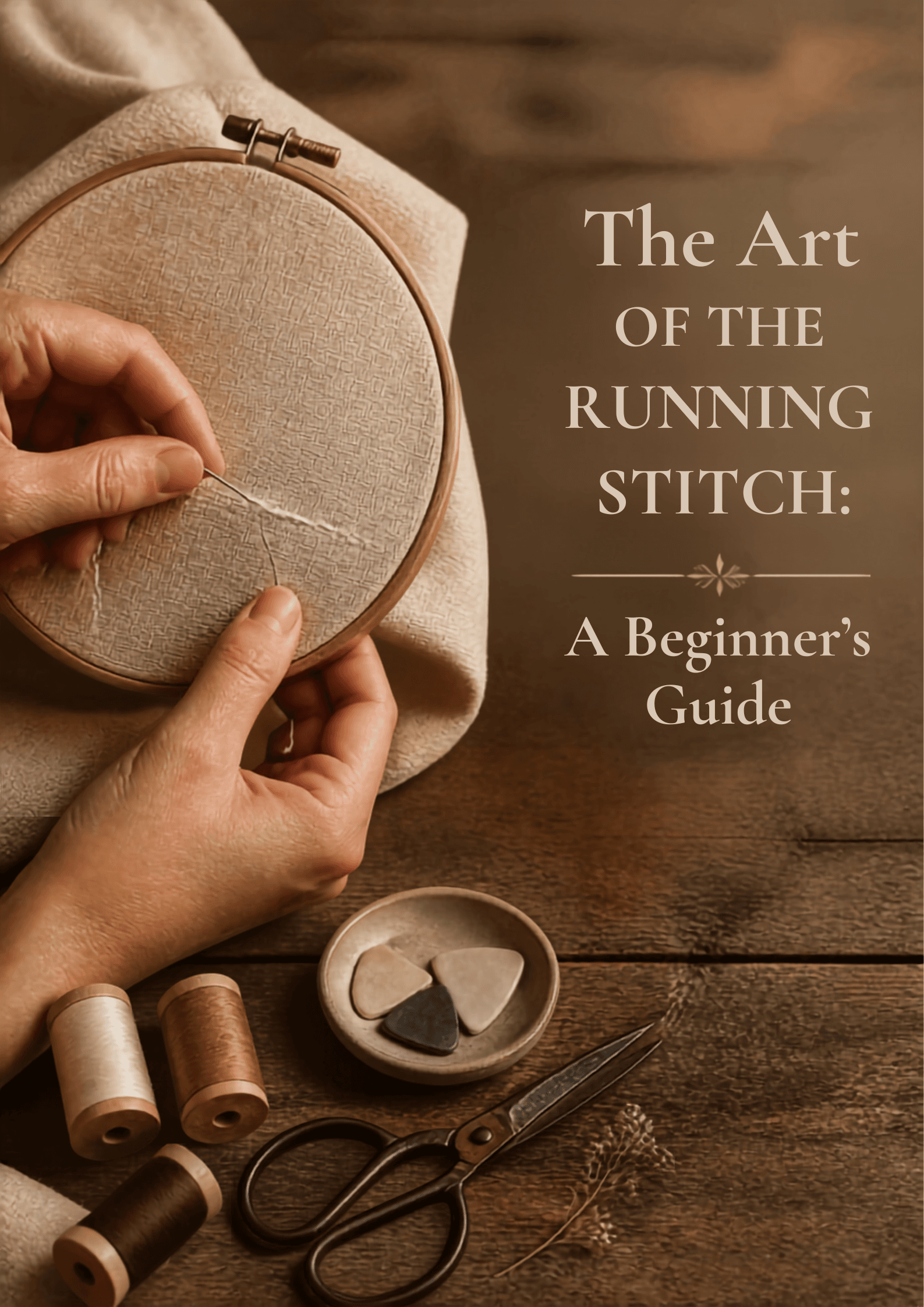
The running stitch is usually the very first stitch anyone learns, and there’s a good reason for that: it’s simple, endlessly adaptable, and it forms the foundation for dozens of other hand-sewing techniques. Simple as it is, though, it turns up in a surprising number of places — garment construction, quilting, embroidery, mending, you name it.
Table of Contents
What Is a Running Stitch?
A running stitch is made by weaving the needle in and out of the fabric along a straight line, leaving a simple dashed pattern of even stitches and gaps on both sides. It can be worked in one pass, or sewn twice along the same line for extra strength — sometimes called a double running stitch, or Holbein stitch.
How to Sew a Basic Running Stitch
- Knot your thread and bring the needle up through the fabric from the back.
- Insert the needle back down a short distance ahead, then bring it back up again the same distance further along, keeping your stitch length and spacing consistent throughout.
- Keep going in that in-and-out motion along a straight or gently curved line.
- For speed, load two or three stitches onto the needle before pulling the thread through — this really speeds things up on long straight lines.
- Secure the end with a knot, or a couple of small backstitches.
Aim for stitches around 1/8 to 1/4 inch long for general use, going shorter for strength or longer if you’re after speed and a more decorative effect.
Uses in Garment Construction
Basting seams: A long running stitch is the classic way to temporarily hold two pieces of fabric together before machine sewing, since it’s easy to remove and adjust as needed.
Gathering fabric: Two parallel rows of running stitch, pulled gently, create even gathers for ruffles, sleeve caps, or waistbands.
Hand-sewn seams on delicate fabric: For fabric too fine or slippery for a machine to handle well, a small, even running stitch can join seams entirely by hand.
Mending small tears: A quick running stitch closes up a small rip, or reinforces a seam that’s starting to give way.
Uses in Quilting
The running stitch is the real backbone of traditional hand quilting, stitched through the quilt top, batting, and backing to hold all three layers together while adding decorative texture at the same time. Quilters aim for small, even stitches, often using a “rocking” motion with a betweens needle to load several stitches on at once.
It also shows up in English paper piecing, a hand-piecing method in quilting where fabric gets basted around paper templates using a plain running stitch before the pieces are whip-stitched together.
Uses in Embroidery
In embroidery, the running stitch pulls double duty as both a functional and a decorative element:
- Outlining shapes in simple line-art-style embroidery
- Filling patterns, when stitched in tightly spaced parallel rows
- Sashiko, the traditional Japanese embroidery technique, which leans almost entirely on precise, evenly spaced running stitches to build geometric patterns
- Whipped or laced running stitch, where a second thread weaves through the original stitches for a raised, cord-like decorative effect
Uses in Mending and Visible Repair
The running stitch sits at the center of visible mending, including sashiko-inspired patchwork repairs, where decorative rows of stitching both reinforce worn fabric and turn the repair into an intentional part of the design.
Tips for Even Running Stitches
- Mark your stitch line lightly with a fabric pen or chalk when consistency matters, especially for decorative embroidery work.
- Keep stitch length and the gaps between stitches roughly equal for a clean, professional look.
- Use a hoop for embroidery projects to keep the fabric taut and stop it from puckering.
- Practice the “rocking” technique with a short needle to speed up several stitches at once — it’s especially handy for hand quilting.
When Not to Use a Running Stitch
Versatile as it is, a running stitch isn’t the strongest stitch in your toolkit. For seams that will take real stress — crotch seams, waistbands under strain, bag straps — a backstitch or a machine straight stitch holds up better, since a running stitch can pull loose more easily under tension.
Final Thoughts
The humble running stitch punches well above its weight. From temporary basting to permanent quilting stitches to intricate sashiko patterns, learning to sew an even, consistent running stitch is a skill that supports nearly every other corner of hand sewing you’ll ever explore.