
Make a tiny loop near the fabric, pull the needle through it, tighten gently, and trim the thread close to the knot.
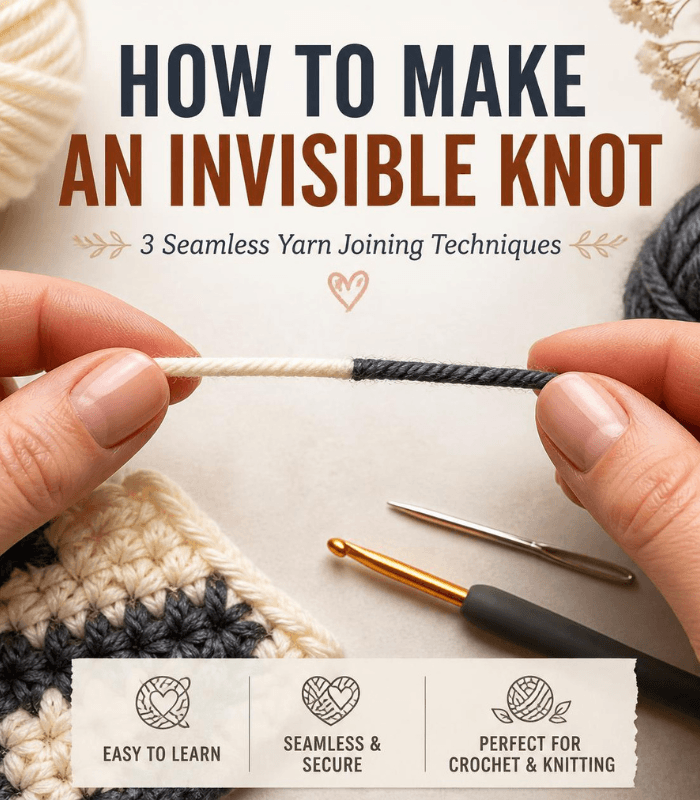
When I teach fiber arts, people always ask the same question: “How do I add new yarn without anyone seeing where I switched colors?” The answer lies in understanding that the “knot” isn’t really a knot at all—it’s a joining method that hides the yarn ends within the fabric itself.
Traditional knots create problems. They’re bulky, visible, and often weaken your work. An invisible join, by contrast, maintains the flow and strength of your piece. This matters whether you’re working on a delicate lace shawl or a sturdy amigurumi.
Table of Contents
The Magic Knot Method
The magic knot is popular because it’s quick and reliable. I recommend it for most crochet work.
Here’s how:
- Hold the old yarn and new yarn parallel, with the new yarn creating a loop
- Weave the old yarn through the new loop
- Pull gently—the old yarn slides through and locks
- Tighten so the join sits at the yarn ends, not in your stitches
- Work the next stitch over both yarn ends; they’ll secure themselves
The magic knot works because you’re not actually tying anything—you’re creating mechanical tension. The beauty is that when you crochet over both ends, they disappear into the stitches. This method is ideal when you need a quick join and plan to hide the ends later anyway.
The Russian Join: Professional Strength
The Russian joining method is my preferred approach for knitting, especially when working with delicate yarns. It creates an absolutely seamless connection.
The process:
- Thread each yarn end through a needle
- Pass the new yarn needle through several stitches of the old yarn, going in one direction
- Reverse and pass back through the same stitches at a slight angle
- Repeat with the old yarn needle through the new yarn
- Pull snug—the yarn ends lock inside the twisted fibers
This technique works because you’re weaving the yarn ends through themselves. The connection becomes part of the yarn structure, not just a surface-level knot. For knitting, especially with variegated or textured yarns, this creates the most invisible join.
Invisible Weaving: The Seamless Approach
When joining yarn at the end of a project—say, finishing off a seam or connecting two pieces—invisible weaving delivers perfection.
The method:
- Thread the yarn end through a needle
- Run the needle horizontally through the stitches of both pieces
- Move diagonally to the next row and repeat
- Create a zigzag pattern that bonds the pieces
- Pull gradually; the pieces should draw together without visible stitching
This technique requires patience but produces results you truly can’t see. It’s worth learning because once you master it, you’ll never want to go back to surface-level joins.
When to Use Each Method
Magic knot: Quick joins during active crocheting, especially with sturdy yarns. Not ideal for delicate or slippery yarn.
Russian join: Best for knitting and fine yarns. Takes longer but produces the strongest, most invisible connection.
Invisible weaving: Finishing work and joining pieces after completion. Requires a tapestry needle and patience but looks flawless.
Tips From My Experience
- Test first: Try each method on scrap yarn before using it on your actual project
- Match your yarn: The method that works for chunky acrylic might fail with delicate merino
- Practice the tension: Too tight and you’ll pucker; too loose and the join slips
- Hide the ends: Even with seamless joining, weave yarn tails through several stitches to secure them
- Don’t rush: A five-minute join beats a one-minute knot that unravels later
Common Mistakes to Avoid
The biggest error I see? Tying knots and hoping to hide them. Knots don’t disappear—they create bulk and weakness. If you’re considering a traditional knot, stop. Spend the extra minute on a proper invisible join instead.
Another mistake: not securing yarn ends afterward. A magic knot needs those tails woven through stitches, or it will come loose.
Why This Matters
Professional-looking work starts with invisible joins. When people ask if you’ve spliced your projects (instead of knitting from a single skein), you know you’ve succeeded. Seamless joining isn’t fancy—it’s foundational.